ONESPORT Ebike Review 2026: 8 Models Compared, Best Picks
ONESPORT ebikes are EU-spec pedelecs capped at 250 W and 25 km/h, sold direct from Poland and Germany. We compare 8 models on battery, range, weight and brakes, and name the best pick for city, cargo and off-road riding.
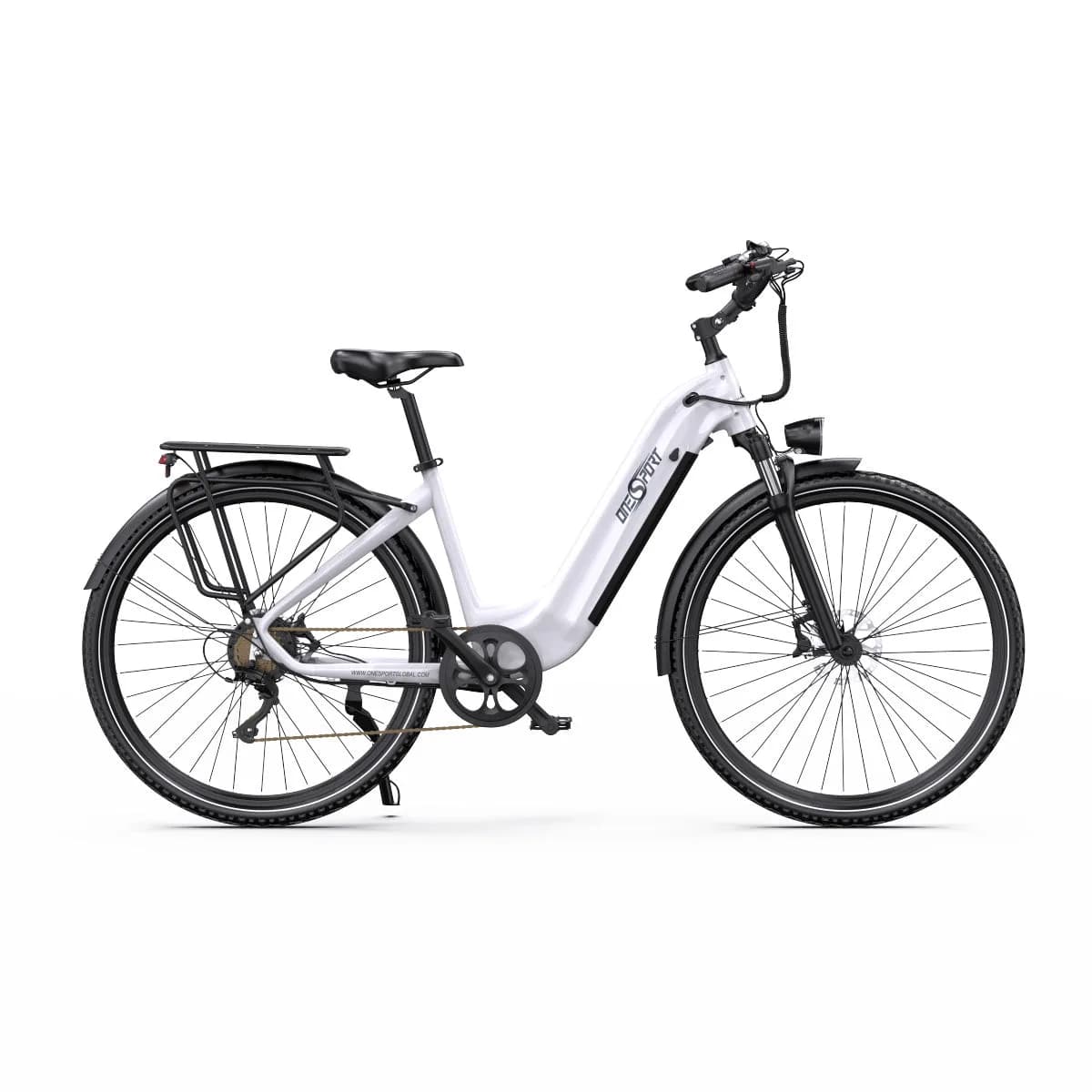
The ONESPORT ebike lineup at a glance
Every ONESPORT ebike is a European-market pedelec capped at 250 W of rated power and 25 km/h of assistance, sold direct from EU warehouses. The brand lists 13 live models spanning folding, fat-tyre, cargo, moped-style and trike formats, with the OT05 Pro as its strongest all-round city commuter.
That EU framing matters more than any single spec. ONESPORT builds for the European pedelec rules rather than the faster North American classes, ships from Poland and Germany, and sells almost entirely direct. This guide breaks the lineup down by format, flags where the numbers are genuinely strong, and names who should skip the brand.
What this guide covers
Key highlights
- Thirteen complete e-bikes are currently listed, alongside a deep catalogue of spare parts and accessories.
- Every model checked runs a 250 W rated motor and a 25 km/h assistance ceiling, matching the EU pedelec definition.
- Range claims run from 80 km on the OT01 cargo bike to 170-190 km on the dual-battery OT08Pro.
- The brand publishes a 2-year warranty, a 14-day return window and free EU shipping from Poland or Germany.
- Main trade-off: these are EU-spec machines, so riders outside Europe get a lower assistance ceiling than local Class 1 and Class 2 bikes.
A credible EU direct-to-consumer pedelec brand with unusually broad format coverage
Choose ONESPORT if you ride in Europe, want direct delivery with taxes covered, and value a torque-sensor commuter or a dual-battery fat bike over brand prestige. Skip it if you are outside the EU shipping list, or if you need a lightweight sub-20 kg road e-bike.
Check current priceThe ONESPORT ebike lineup at a glance
ONESPORT sells thirteen complete e-bikes at the time of writing, and the catalogue is deliberately format-led rather than tier-led. Instead of one platform in three battery sizes, you get distinct machines: road commuters, folding fat bikes, a full-suspension off-roader, a long-tail cargo bike, a moped-style dual-seater and a three-wheeled trike.
Named models currently listed are the OT02, OT12, W77, OT30 Pro, OT16 Max, OT05 Pro, OT08, OT08Pro, W66, OT07, OT01, OT05 and OT16-2. The remainder of the store is spare parts, batteries and rider accessories, which is a useful signal in itself: a brand stocking derailleurs, controllers and replacement forks for named models is planning to support them.

Two things stand out when you read the spec sheets side by side. First, the motor story is consistent: 250 W rated across the board, with several models quoting a 500 W peak. Second, the batteries are not consistent at all, ranging from a 36 V 14 Ah pack on the OT07 to a 48 V 27 Ah pack on the OT01. Battery capacity, not motor power, is what separates these bikes.
Onesport OT05 Pro City E-Bike
The one model that combines a torque sensor, hydraulic disc brakes and a long-range battery in a road-tyre commuter frame.
Check current priceAre ONESPORT ebikes road-legal in the EU?
Yes, on the published specifications. EU law treats a pedal cycle as a bicycle rather than a motor vehicle when the motor is limited and assistance stops at a set speed, and every ONESPORT spec table checked sits inside those limits.
The governing text is Regulation (EU) No 168/2013, which excludes from type-approval "pedal cycles with pedal assistance which are equipped with an auxiliary electric motor having a maximum continuous rated power of less than or equal to 250 W, where the output of the motor is cut off when the cyclist stops pedalling and is otherwise progressively reduced and finally cut off before the vehicle speed reaches 25 km/h".
Alongside the law sits EN 15194:2017, the European standard covering electrical, mechanical, performance and labelling requirements for electrically power assisted cycles. It applies to systems rated up to 48 V d.c., which covers the whole ONESPORT range.
The practical consequence is simple. In the EU you need no licence, insurance or registration for these bikes. Outside the EU the same machines are simply slower than local rules allow, because a North American Class 1 or Class 2 bike may assist to 20 mph. That is not a defect, but it is the single most common source of disappointed reviews for EU-spec brands.
Which ONESPORT ebike should you buy?
Four models cover the great majority of real buying situations. Each card below reflects the manufacturer's published specification sheet for that model, not a road test.

Onesport OT05 Pro City E-Bike
What We Like
- Torque sensor rather than a simple cadence switch, so assistance tracks how hard you actually push.
- Longest claimed range of any single-battery model in the lineup.
- IPX5 rating and 700x50C road tyres with reflective sidewalls.
What to Consider
- Torque figure is modest, so steep starts lean on the Shimano gears.
- At 29 kg it is not a bike you carry upstairs.
The OT05 Pro is the model that best justifies the brand. A torque sensor at this position in the market is not a given, and pairing it with a 36 V 22.5 Ah battery and hydraulic discs makes it a genuinely complete commuter. The butterfly handlebar and 80 mm suspension fork are aimed squarely at longer urban rides, and the detachable aluminium rack keeps the pannier option open.

Onesport OT16 Max Folding E-Bike
What We Like
- Publishes both a pure-electric and an assisted range figure, which is rarer and more honest than a single headline number.
- Lightest of the fat-tyre models here despite the 18 Ah pack.
- Aluminium frame with IPX5 rating.
What to Consider
- Rear rack is non-detachable, limiting rack-swap options.
- Folded fat bikes are still bulky; this is boot-friendly, not train-friendly.
The OT16 Max is the pick if storage is your binding constraint. Publishing 60 km in pure electric mode against 120 km assisted is a useful piece of transparency, because it tells you what happens when you stop pedalling rather than leaving you to guess. Braking is handled by 180 mm rotors, and the 4-level assist display is straightforward.

Onesport OT08Pro Full Suspension E-Bike
What We Like
- Dual-battery layout gives the longest claimed range in the range by a wide margin.
- True full suspension rather than a front fork alone.
- Magnesium alloy one-piece wheels on 20x4 inch off-road tyres.
What to Consider
- Heaviest road-going model here, and the rear rack is not detachable.
- IPX4 rather than IPX5, so it is rated for less water ingress than the OT05 Pro.
- Charging two packs at 2 A takes a full working day.
If range is the deciding factor, this is the model. Two 18 Ah packs at 48 V is a serious amount of stored energy for a pedelec, and the full-suspension frame is what makes using it plausible over rough ground. The trade-off is mass and charge time: at 39.2 kg it is a bike you ride from home, not one you lift into a van single-handed.

OneSport OT01 Cargo E-Bike
What We Like
- Largest single battery in the lineup at 27 Ah.
- Adjustable handlebar and saddle height make it genuinely shareable between riders.
- A matching child rear seat is sold by the brand rather than left to third parties.
What to Consider
- Single-speed gearing and a 20 degree maximum climbing angle, the lowest of the models reviewed.
- 160 mm rotors on a bike that can carry 150 kg.
Cargo bikes live or die on battery and stability, and the OT01 gets the battery right with 48 V 27 Ah. The honest caveat is the drivetrain: single-speed gearing plus a 20 degree climbing limit means hilly cities will work the motor hard when the bike is loaded. On flat urban routes with a child seat fitted, it is the most useful bike here.

Onesport W66 Moped E-Bike
What We Like
- Highest load rating in the lineup, shared only with the OT30 Pro trike.
- Hydraulic discs front and rear plus front and rear suspension.
- Bluetooth LCD display and the shortest charge time of the group.
What to Consider
- Smallest battery of the models reviewed, so the range claim depends heavily on assist level.
- Steel frame and moped styling make it the least bicycle-like option.
- Local rules on carrying a passenger vary; check before you buy.
The W66 is the outlier. A 180 kg load rating and a dual seat put it closer to a scooter in use, while the pedals and 250 W rated motor keep it legally a pedelec. Charge time is quoted at 7-8 hours, the quickest here, which follows from the smaller pack. Buy it for the format, not the battery.
Model comparison table
The table below puts the published figures side by side. Range values are manufacturer claims in power-assisted mode and will fall with rider weight, terrain and assist level.
| Model | Battery | Claimed range | Net weight | Best for |
|---|---|---|---|---|
| OT05 Pro | 36 V 22.5 Ah | 130-140 km | 29 kg | City commuting |
| OT16 Max | 48 V 18 Ah | 120 km | 31.45 kg | Folding storage |
| OT08Pro | Dual 48 V 18 Ah | 170-190 km | 39.2 kg | Off-road range |
| OT08 | 48 V 18 Ah | 80-90 km | 37.5 kg | Fat-tyre commuting |
| OT01 Cargo | 48 V 27 Ah | 80-100 km | 41.7 kg | Family cargo |
| OT07 | 36 V 14 Ah | 70-90 km | 24 kg | Lightest road option |
| W66 | 48 V 13.5 Ah | 80 km | 39 kg | Two-up moped style |
| OT30 Pro | 48 V 18 Ah | 80-90 km | 43.25 kg | Three-wheel stability |
One row deserves a second look. The OT07 weighs 24 kg, roughly 15 kg less than the fat-tyre models, and pairs a mid-drive layout with an 80 Nm torque figure and a BAFANG controller. If you want the lightest bike ONESPORT makes and can live with a smaller battery, that is the one to look at rather than the headline models.
How do you choose between folding, fat-tyre and cargo models?
Work from your constraint backwards. Most people buy the format they like the look of and then discover the constraint later. Reverse it and the choice usually makes itself in five steps.
- Fix your storage. If the bike lives in a flat, a hallway or a car boot, you are choosing a folding model and every other criterion follows from that.
- Set a real range target. Take your longest regular round trip and double it, then compare against the assisted claim rather than the pure-electric one.
- Check the climbing angle, not just the torque. A 20 degree limit and a 30 degree limit behave very differently on a loaded bike.
- Decide whether you need a torque sensor. If the ride should feel like a bicycle rather than a throttle, that narrows the list quickly.
- Confirm delivery and support in your country before anything else, because a direct-to-consumer brand is only as good as its logistics.
Battery capacity is the real differentiator
Because every model shares the same 250 W rated motor, the spec that actually changes your experience is stored energy. A 48 V 27 Ah pack holds far more than a 48 V 13.5 Ah one, and that gap explains most of the range spread in the table above far better than any motor figure does.
Torque sensor versus cadence assist
The OT05 and OT05 Pro use a torque sensor, which measures how hard you press the pedals and scales assistance accordingly. Most of the rest use level-based pedal assist, which delivers a set amount of help once you start turning the cranks. Neither is wrong; the torque-sensed bikes simply feel more like riding a bicycle, while level-based assist is easier for riders with limited pedalling strength.
Brakes, waterproofing and weight
Hydraulic disc brakes appear across the lineup, but rotor sizes vary from 160 mm on the OT01 to 180 mm on the OT16 Max. Water resistance splits the range too: the OT05 Pro is IPX5 while the OT08Pro is IPX4. If you commute year-round in wet weather, that distinction is worth more than a few kilometres of claimed range.
Common buying mistakes to avoid
Three errors account for most regret purchases with EU direct-to-consumer e-bike brands, and all three are avoidable before you check out.
- Reading the assisted range as a guaranteed range. Assisted figures assume a cooperative rider on flat ground at a low assist level. Treat them as a ceiling, not an expectation.
- Ignoring shipping eligibility. The brand's free shipping list covers specific European countries; ordering from outside the listed region is the fastest route to a cancelled order.
- Underestimating weight. At 41.7 kg for the OT01 and 43.25 kg for the OT30 Pro, these are not bikes you lift onto a roof rack casually. Confirm your storage and transport plan first.
Before ordering, it is also worth checking the practical support picture. ONESPORT publishes separate pre-sales and after-sales email addresses plus phone lines for France, Czechia and Slovakia, staffed Monday to Friday. For a direct brand with no dealer network, that is the channel you will actually depend on.
Alternatives worth comparing
ONESPORT is not the only EU-focused direct brand, and the sensible move is to compare formats rather than logos. If you are new to the category, start with our complete guide to buying your first electric bike, which walks through the specifications that matter before brand comes into it.
For riders whose budget is the binding constraint, our roundup of the best budget electric bikes of 2026 covers the same commuter and fat-tyre formats across several brands. If you would rather electrify a bike you already own than buy a complete machine, the Bafang mid-drive conversion kit guide is the more economical route and keeps a frame you already trust.
Within the fat-tyre segment specifically, brands such as SMLRO and OUXI compete directly with the OT08 and OT16 Max on format and battery size, so their strengths are worth acknowledging before you commit to any single brand.
How We Chose
We worked from the manufacturer's own published specification tables for each model, cross-checked the motor and speed figures against the text of Regulation (EU) No 168/2013, and read the brand's shipping, refund and contact pages for the support picture. No road testing was carried out; every performance figure quoted here is a manufacturer claim and is labelled as such.
The verdict on ONESPORT
ONESPORT earns a recommendation for European riders who want unusual format breadth from one brand and are comfortable buying direct. The OT05 Pro is the model to start with, the OT08Pro is the range champion, and the OT01 is the most genuinely useful if you carry cargo or a child. Skip the brand if you ride outside its EU shipping list, need a bike under 20 kg, or want assistance beyond the 25 km/h pedelec ceiling.
View the full ONESPORT rangeReferences
- European Parliament and Council. Regulation (EU) No 168/2013 on the approval and market surveillance of two- or three-wheel vehicles and quadricycles, Official Journal of the European Union L 60, 2 March 2013.
- British Standards Institution. BS EN 15194:2017 Cycles — Electrically power assisted cycles — EPAC Bicycles.
This article is for general information only and is not legal or safety advice. E-bike classification, speed limits and passenger rules differ by country and can change; confirm the rules that apply where you ride before buying. All specifications and range figures are manufacturer claims taken from the brand's published product pages on the date shown above and may be revised without notice. Always follow the manufacturer's charging and maintenance instructions.
More E-Bikes & Scooters guides
 ONECNA GT7 Review 2026: Specs, Range and Real Repairability
 Tuttio Electric Bike Guide: 4 Models Compared Safely (2026)
 NIU Electric Scooter vs E-Bike: Best Model Guide (2026)
 A-Spadz CAVET Review: Moped-Style Electric Bike
 A-Spadz CAVET Buying Guide: 3 Models Compared for 2026
 Off-Road Electric Scooter: 6 Best Buying Criteria (2026 Guide)