Varstrom E-Bike Conversion Batteries: How to Pick the Right Voltage & Capacity
A practical guide to choosing the right Varstrom e-bike conversion battery — comparing 36V, 48V, and 52V downtube and rear-rack packs by capacity, BMS discharge rating, and kit compatibility.
Voltage basics: 36V vs 48V vs 52V
- Voltage basics: 36V vs 48V vs 52V
- Capacity and range: reading Ah and Wh
- BMS discharge rating and why it matters
- Downtube vs rear-rack battery mounting
- Matching a Varstrom battery to your kit
- Varstrom battery comparison table
- Charging, warranty, and battery care
- Common mistakes when picking a conversion battery
A Varstrom e-bike conversion battery is the power source you pair with a mid-drive or hub kit, and choosing the wrong voltage or capacity leaves range, hill-climbing, and BMS headroom on the table. This guide breaks down 36V, 48V, and 52V Varstrom packs so you can match voltage and Ah to your Bafang or TongSheng TSDZ kit.
Voltage sets how much torque and top-end power your motor controller can push, while amp-hours (Ah) set how far you ride before recharging. Unlike swapping a stock e-bike battery for a same-spec replacement, a conversion build lets you choose voltage and capacity independently — which means it also lets you choose wrong if you skip the controller and BMS math below.
- Voltage basics: 36V vs 48V vs 52V
- Capacity and range: reading Ah and Wh
- BMS discharge rating and why it matters
- Downtube vs rear-rack battery mounting
- Matching a Varstrom battery to your kit
- Varstrom battery comparison table
- Charging, warranty, and battery care
- Common mistakes when picking a conversion battery
Match voltage to your controller first, then size Ah for your longest regular ride
Riders with a 750W-class Bafang BBSHD generally want 48V or 52V for discharge headroom; TSDZ mid-drive builds usually pair best with a 36V pack sized to the motor's lower peak draw.
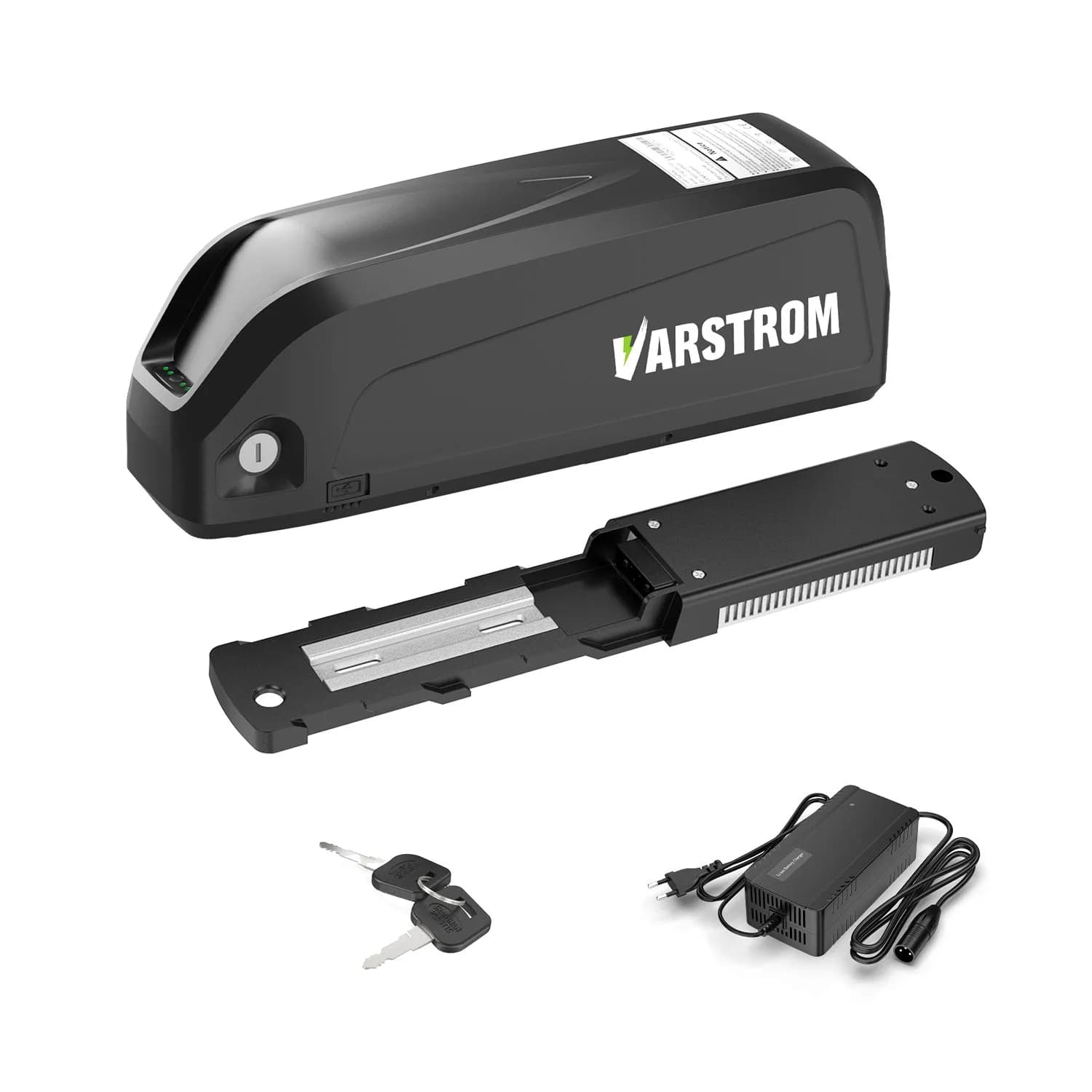
Check current price at Varstrom- Varstrom 48V downtube packs span 10.4Ah (500Wh) up to 30.0Ah (1440Wh), so the same voltage line covers commuters and long-range riders alike.
- All Varstrom downtube and rack batteries in this line share the same BMS ceiling: 30A continuous / 60A peak discharge — enough headroom for a Bafang BBSHD pulling hard on a climb.
- A 52V 25.0Ah pack steps up to a 40A BMS, built specifically to match the higher peak draw of a BBSHD kit.
- Rear-rack batteries (48V 17.5Ah / 36V 22.5Ah / 52V 17.5Ah) solve the problem of frames with no downtube mounting bosses.
Voltage basics: 36V vs 48V vs 52V
A Varstrom e-bike conversion battery's voltage sets the ceiling for how much power your motor and controller can draw before the BMS steps in. 36V systems are the traditional baseline for lighter mid-drives like the TongSheng TSDZ; 48V is the most common choice for Bafang BBS-series kits; 52V is a step up used mainly with higher-power BBSHD builds that want extra headroom under load.

Higher voltage doesn't automatically mean more range — it means more available power at a given current draw. Range comes from Ah and Wh, covered next. Voltage compatibility with your controller is non-negotiable: a 52V pack on a controller rated only for 48V can push the system past its safe operating window.
Capacity and range: reading Ah and Wh
Amp-hours (Ah) and watt-hours (Wh) tell you how far a Varstrom conversion battery can take you before a recharge, and the two numbers scale together with voltage. Varstrom's 48V downtube line alone spans 10.4Ah (500Wh) up to 30.0Ah (1440Wh), which is a wide enough range to cover a short commuter build and a long-distance touring build on the same voltage platform.
At the entry end, the 36V 13.0Ah (468Wh) pack uses DMEGC 18650-26E cells and weighs about 3.0kg, sized for a TSDZ build where lower weight on the downtube matters. On the higher end, the 52V 20.0Ah (1040Wh) pack built with Samsung INR21700-50E cells weighs roughly 5.0kg and is rated for over 1,000 charge cycles.
As a rough rule: double the Wh roughly doubles usable range at a given power draw, but adds weight to the frame. For shorter, mostly-daily commutes, a mid-capacity pack keeps the bike lighter; long-distance riders should size up rather than plan on frequent mid-ride recharges.
BMS discharge rating and why it matters
The battery management system's continuous and peak discharge rating decides whether your Varstrom e-bike conversion battery can actually deliver the current a Bafang BBSHD demands on a steep climb, not just on paper. Most of the Varstrom downtube and rack line ships with a 30A continuous / 60A peak BMS, connected through an XT60 connector.

The 52V 25.0Ah variant steps that up to a 40A BMS, built specifically for the extra peak current a BBSHD can draw under load. If your controller and motor are rated near or above the pack's continuous discharge ceiling, the BMS will throttle or cut power mid-climb — check your kit's peak-current spec before assuming any 48V or 52V pack is interchangeable.
For a deeper breakdown of which Bafang mid-drive kits pair with which voltage class, see our Varstrom Bafang mid-drive conversion kit buyer's guide.

Varstrom 48V Downtube Battery
Available from 10.4Ah up to 30.0Ah, with a 30A/60A BMS matched to most Bafang BBS-series kits.
Check current price at VarstromDowntube vs rear-rack battery mounting
Not every conversion frame has downtube mounting bosses, which is why Varstrom also builds a rear-rack line: 48V 17.5Ah, 36V 22.5Ah, and 52V 17.5Ah options, each shipped with a matching charger and XT60 connector. A rear-rack battery mounts over the rear wheel instead of the frame, which is the practical fix when your donor bike's downtube was never designed to carry a pack.
Downtube mounting keeps weight centered and low, which most riders prefer for handling on a mixed-use commuter or trail build. Rack mounting trades some of that centered balance for compatibility with frames that simply have no other option — it's a fit decision as much as a performance one.
Matching a Varstrom battery to your kit
Start with your motor kit, not the battery. A TongSheng TSDZ mid-drive draws less peak current than a Bafang BBSHD, so a 36V pack in the 13.0Ah/468Wh range is typically enough headroom without adding unnecessary weight. A Bafang BBS02 usually runs well on a 48V pack in the low-to-mid Ah range, while a BBSHD — which can pull closer to its controller's peak rating on steep climbs — benefits from the extra discharge headroom of a 52V pack.
- Confirm your controller's rated voltage (36V, 48V, or 52V) — this is fixed and non-negotiable.
- Check your motor kit's peak current draw against the battery's continuous BMS rating, not just its peak rating.
- Estimate your longest regular ride distance, then pick the Ah/Wh tier that covers it with margin.
- Confirm your frame has downtube mounting bosses; if not, plan for a rear-rack battery instead.
Varstrom battery comparison table
| Battery | Capacity | Cells | BMS discharge | Best for |
|---|---|---|---|---|
| 36V 13.0Ah Downtube | 468Wh | DMEGC 18650-26E | 30A / 60A | TongSheng TSDZ builds |
| 48V Downtube (10.4-30.0Ah) | 500-1440Wh | Samsung/LG/EVE/DMEGC 21700 & 18650 | 30A / 60A | Bafang BBS-series builds |
| 52V 20.0Ah Downtube | 1040Wh | Samsung INR21700-50E | 30A / 60A | Bafang BBSHD builds |
| 52V 25.0Ah Downtube | 1300Wh | LG INR21700 M50LT | 40A | High-power BBSHD builds |
| Rear-Rack (48V/36V/52V) | 17.5-22.5Ah | — | — | Frames without downtube bosses |
Charging, warranty, and battery care
The 36V line charges at 42V, 2A (DC2.1) or 3A/4A (XLR), while the 52V line charges at 58.8V, 3A (DC2.1) or 4A (XLR) — always match the charger's connector and voltage to your specific pack, never mix packs and chargers across voltage classes. Every Varstrom battery in this line carries a 1-year free warranty plus 2 years of after-sales maintenance support, matching the 1-year warranty length Varstrom also applies to its motor kits and displays.
Store a conversion battery partially charged rather than full when it will sit unused for weeks, keep it away from freezing or high-heat storage, and avoid leaving it on the charger long after it reaches full charge. These are general lithium-battery care habits, not Varstrom-specific claims.
Common mistakes when picking a conversion battery
- Buying by Ah alone. Two packs with the same Ah at different voltages store very different Wh — always compare Wh, not just Ah, when weighing range.
- Ignoring BMS continuous discharge. A high peak rating looks good on a spec sheet, but sustained climbing draws on the continuous rating — check both.
- Mismatching voltage to the controller. Running a 52V pack on hardware rated for 48V pushes the system outside its intended operating range.
- Skipping the mounting check. Ordering a downtube battery for a frame with no mounting bosses means a rack battery was the right call all along.
Verdict: match the kit first, then size for range
For most Bafang BBS/BBSHD conversion builds, a Varstrom 48V downtube battery sized to your longest regular ride is the safest starting point; BBSHD riders pushing steep climbs should look at the 52V line for the extra BMS headroom. TSDZ builds are better served by the lighter 36V pack. See our full Varstrom Bafang mid-drive kit buyer's guide for motor-side compatibility details.
Check current price at VarstromSources
This article is for general buying guidance only. Always confirm voltage compatibility with your specific motor controller before purchasing, and follow the manufacturer's charging and safety instructions for any lithium-ion e-bike battery.
More E-Bikes & Scooters guides
 Asiwo MAKO Review 2026: Best Entry-Level Sea Scooter?
 Soleil Supplies Review 2026: Best Tuttio & Yozma Upgrade Parts
 KuKirin Electric Scooters: Safe Buyer's Guide to All 14 Models (2026)
 ONESPORT Ebike Review 2026: 8 Models Compared, Best Picks
 ONECNA GT7 Review 2026: Specs, Range and Real Repairability
 Tuttio Electric Bike Guide: 4 Models Compared Safely (2026)