Marine Watermaker Guide for Liveaboard Cruising: Onboard Desalination Explained
A marine watermaker converts seawater into drinking water at anchor or underway. Here is how onboard reverse-osmosis desalination works, how to size a system for your crew, and why offshore sailors carry one aboard.
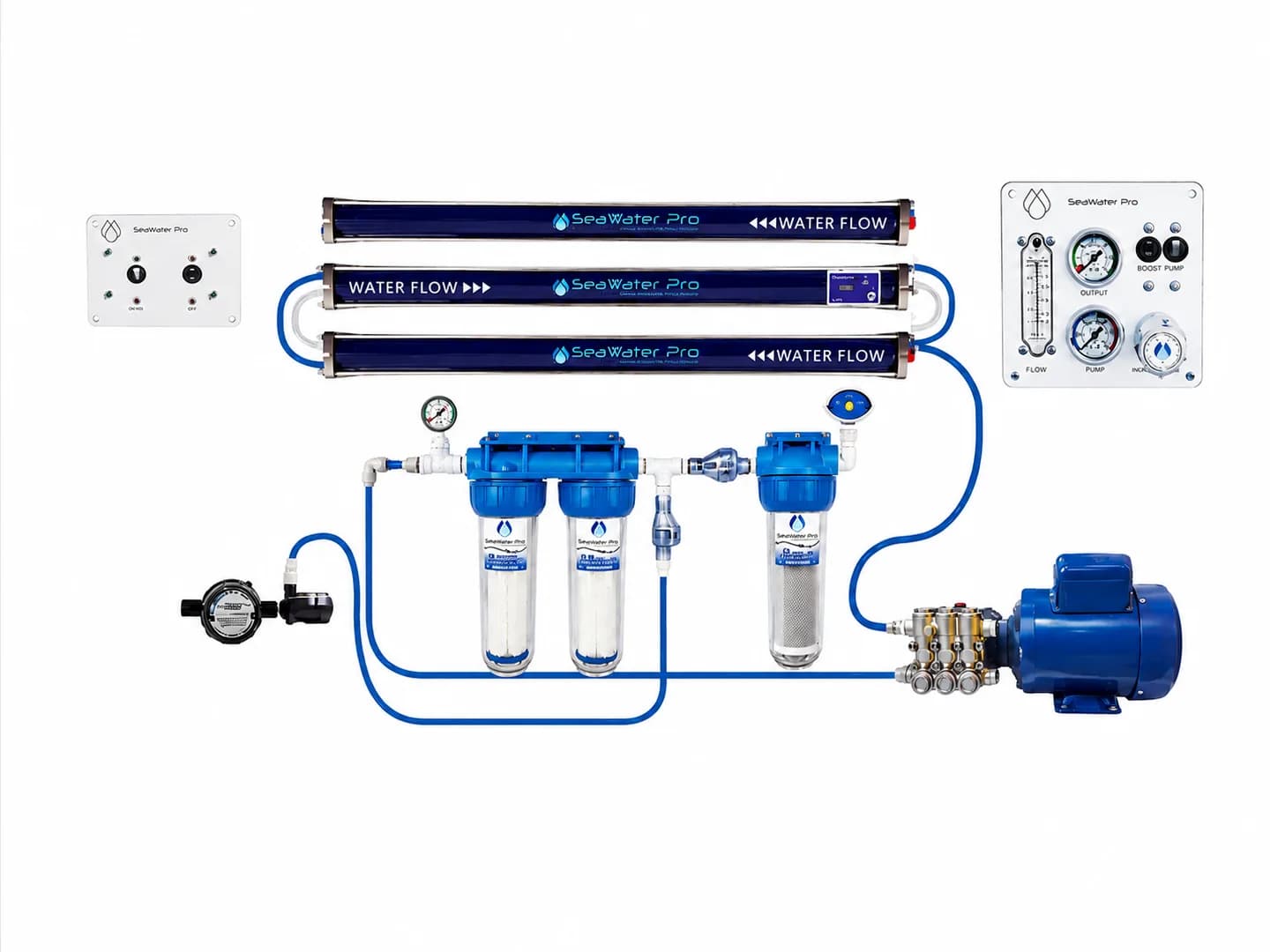
How a marine watermaker works
A marine watermaker turns raw seawater into drinkable fresh water right on board, using reverse-osmosis pressure instead of dock hoses or jerry cans. For liveaboard and offshore sailors, that single system can be the difference between rationing water on a three-week passage and running the galley, showers, and washdown freely at anchor.
Sea Water Pro's 12V/24V DC watermakers are built for cruising sailboats and liveaboard yachts running on battery banks and solar
Crews on a single sailboat with modest daily needs typically fit best on a 12V DC model; larger yachts or full-time liveaboards with more crew usually need the 24V dual-membrane step-up. Either way, a marine watermaker replaces marina fill-ups and rationed tanks with fresh water made on demand.
See Sea Water Pro Marine WatermakersKey Highlights
- Marine RO systems reject roughly 95–99% of salt, producing potable water straight from the ocean.
- DC models integrate directly with a boat's battery bank and pair with solar or wind for power independence at anchor.
- Sailing yachts typically size for 30–60 liters (about 8–16 gallons) per hour of output.
- Energy-recovery devices can cut total power draw by 20–30% on systems that use them.
How a marine watermaker works
A marine watermaker draws seawater in below the waterline, runs it through pre-filtration stages to strip out sediment and suspended solids, then a high-pressure pump pushes it to roughly 600–1,000 psi through a semi-permeable RO membrane. The membrane splits the flow into clean permeate (drinking water) and concentrated brine that gets pumped back overboard. The result is typically 95–99% salt rejection straight from open ocean water.
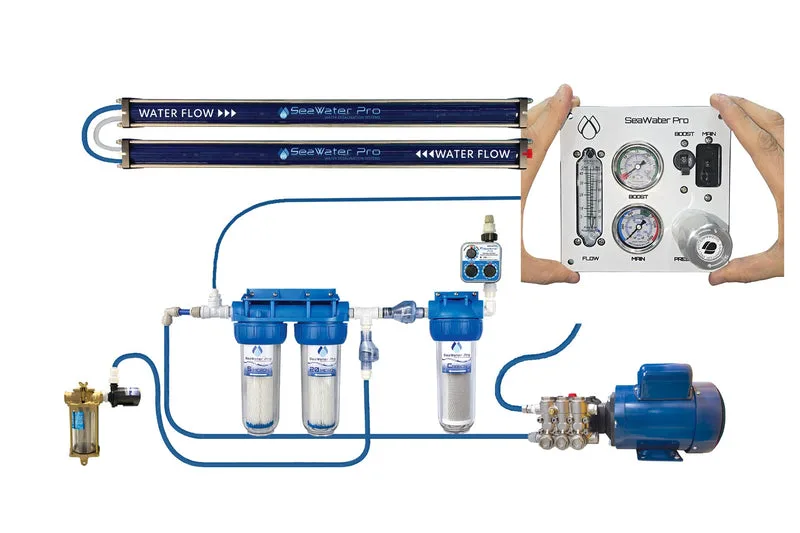
Every Sea Water Pro system shares this same core RO process. The difference between models comes down to how much water they produce per hour and what powers the high-pressure pump, which is the real decision point for a cruising sailor.
AC vs DC power aboard: which suits your boat
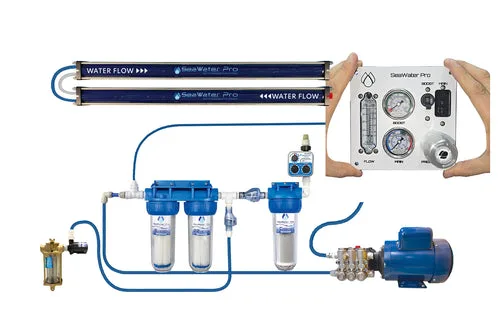
Sea Water Pro 12V DC Single Membrane
17 GPH output at 600W: runs off house batteries topped up by solar or wind.
Most cruising boats choose between a DC system wired to the house bank or an AC unit that needs an inverter or shore/generator power. Sea Water Pro's 12V DC single-membrane model produces 17 gallons per hour at 600 watts and is built for sailboats, catamarans, and liveaboard vessels where AC power is limited or unavailable. It can be paired with solar panels or a wind generator for real energy independence at anchor. Step up to the 24V DC dual-membrane model and output rises to 40 gallons per hour at 900 watts, aimed at larger motor yachts and commercial marine operations with a bigger daily fresh-water demand.
For occasional or backup use, Sea Water Pro also builds a Mini Portable AC-powered watermaker meant for camping, sailing trips, and remote off-grid adventures. On a sailing trip it produces roughly 12–14 gallons per hour from open ocean or brackish sources, and its compact, lightweight build means it can be set up and stowed by anyone with basic DIY skills, a useful backup for boats that don't want a permanently plumbed DC system.
The practical rule: if your boat already runs primarily on battery banks and renewable charging, a DC model avoids running an inverter or generator just to make water. If you have reliable AC power at the dock or via generator and only need water occasionally, a portable AC unit adds flexibility without a permanent through-hull installation.
Sizing a marine watermaker for your crew
Sailing yachts typically carry systems producing 30–60 liters (about 8–16 gallons) per hour, which is enough for crew needs over multi-day offshore passages, while larger motor yachts and commercial vessels run systems generating several hundred liters per hour. Sizing comes down to crew size, voyage duration, and how much power you can generate underway.
Sea Water Pro's range spans 12 gallons per hour on the portable AC model up to 60 gallons per hour on the triple-membrane residential-class system, so sizing is really about matching daily consumption to available power. A single sailor or cruising couple usually fits a 12–17 GPH 12V DC unit; a family of four aboard, or an off-grid setup, may need 20–40 GPH; a motor yacht or larger vessel benefits from 40–60 GPH capacity. Oversizing burns more power than you need, while undersizing leaves you short during a long passage or a dry spell at anchor. Most experienced cruisers size for peak demand, then run the system intermittently rather than continuously.
| Model | Power source | Output |
|---|---|---|
| Sea Water Pro Mini Portable | AC, plug-in | ~12–14 GPH |
| Sea Water Pro 12V DC Single Membrane | DC, house battery / solar | 17 GPH at 600W |
| Sea Water Pro 24V DC Dual Membrane | DC, house battery / generator-assist | 40 GPH at 900W |
Energy recovery and efficiency offshore
Advanced marine RO systems now use energy-recovery devices that capture hydraulic energy from the brine (reject water) discharge stream and reuse it to assist water flow and pressure generation. This matters most on vessels with limited electrical resources, particularly sailing yachts and off-grid marine installations, because it can cut total power consumption by 20–30%, which stretches engine runtime and battery charge cycles between generator sessions.
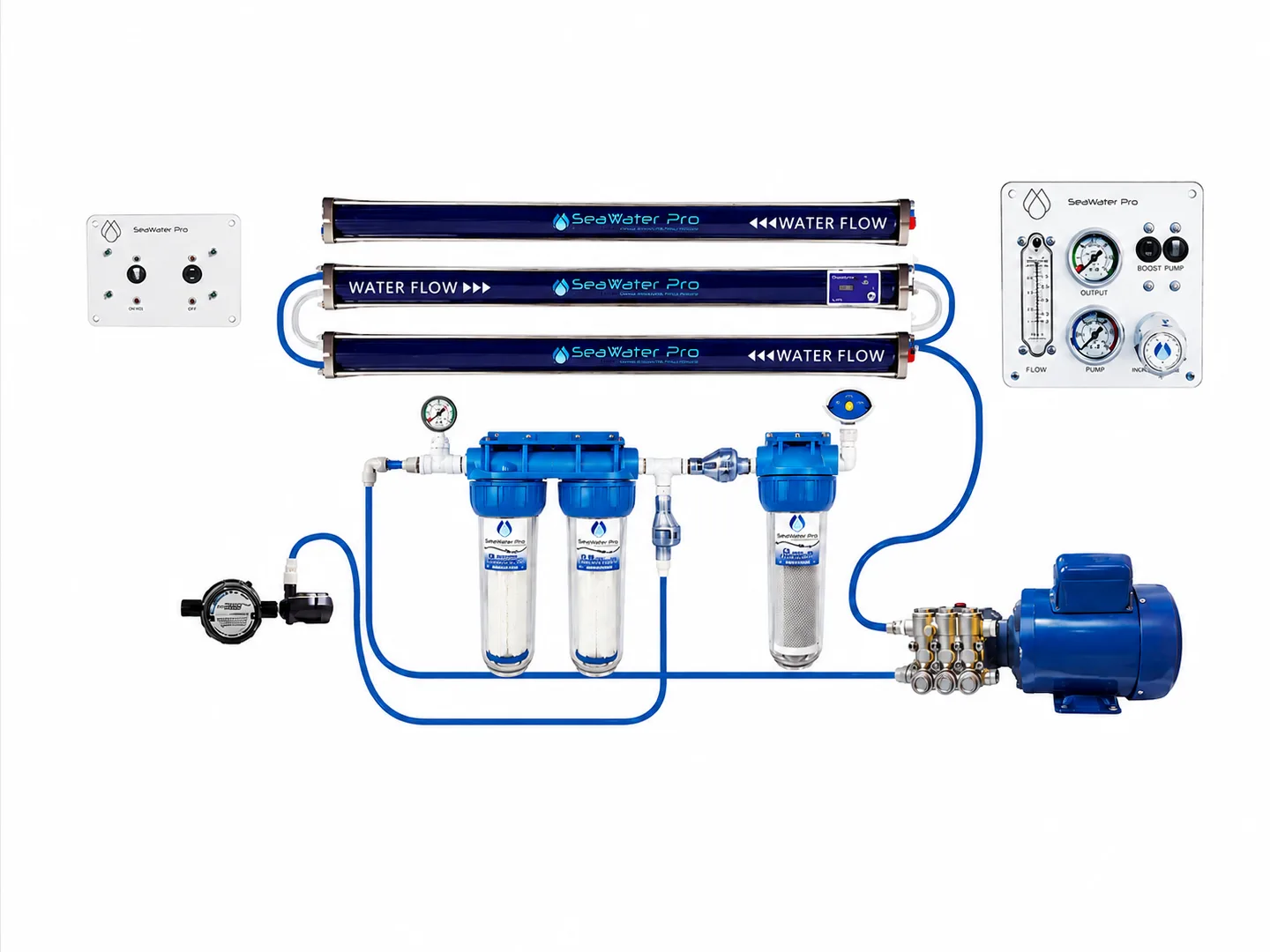
For a cruiser weighing DC options, energy recovery is one of the clearest levers for keeping a marine watermaker compatible with a modest solar and battery setup, rather than forcing daily generator runs just to top off the tanks.
Maintenance and membrane life
RO membranes on marine and off-grid watermakers typically last 3–5 years with correct use and regular maintenance, and some reach 6–7 years under ideal conditions: clean feed water, consistent pressure, and protection from fouling. Pre-filters are the first line of defense: replacement is usually needed every 3–6 months depending on water clarity, with murkier coastal or high-plankton water demanding more frequent changes than clear offshore seawater.
Once a membrane fouls with salt deposits or biofilm, chemical cleaning is often not enough to restore it, roughly 90% of fouled membranes that go through chemical cleaning never fully regain their original performance, so preventive care beats trying to rescue a failed one. For any extended shutdown of more than two to three weeks, pickling the membrane housing with a biocide solution protects it for up to six months; longer layups call for a thorough flush and re-pickle. This is standard practice for seasonal boats and liveaboards who haul out or leave a vessel unattended over winter.
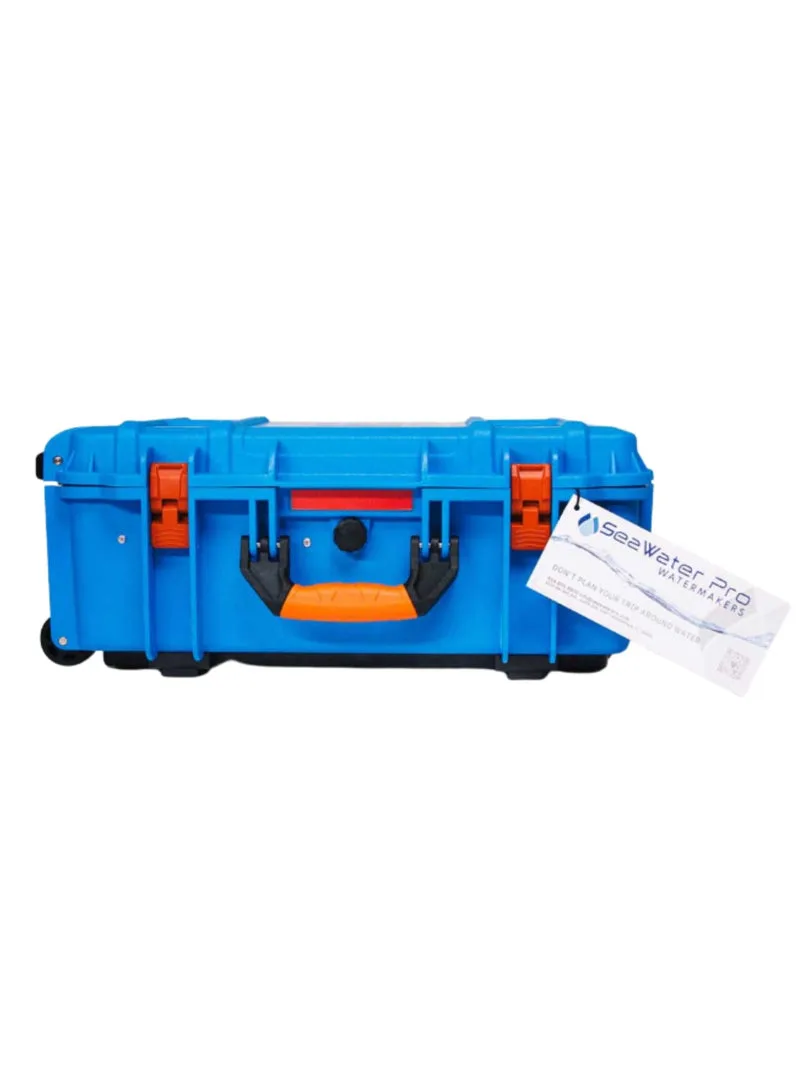
Sea Water Pro 24V DC Dual Membrane
What We Like
- Higher output supports more crew without running the pump longer
- Integrates with a boat's existing DC electrical system
- Stainless pressure vessels built for continuous saltwater duty
What to Consider
- Higher power draw needs a larger battery bank or more charging capacity than the 12V single-membrane model
For liveaboards and crews of three or more, the dual-membrane step-up trades a bit more power draw for roughly double the hourly output of the entry 12V model, which shortens the time the system needs to run per day.
Why offshore sailors carry a marine watermaker
Offshore passages and remote anchorages mean marina fill-ups aren't always available, and carrying enough tankage for a full crew over weeks of cruising eats into space better used for stores, spares, or provisions like a properly insulated cooler for keeping food fresh on long passages. A marine watermaker turns that equation around: instead of rationing water or planning routes around the next marina, the boat produces fresh water from the ocean it's already sailing on.
That independence compounds with the DC/solar pairing above: a well-sized system with energy recovery can run quietly off the house bank at anchor, refilling tanks during daylight hours without touching the generator. Combined with the maintenance routine above (fresh pre-filters, seasonal pickling, and membrane monitoring), a marine watermaker becomes one of the lower-maintenance systems on a well-equipped cruising boat rather than a fragile piece of gear to babysit.
The Bottom Line
For solo sailors and cruising couples, Sea Water Pro's 12V DC single-membrane watermaker is the practical starting point, enough output for daily needs at a power draw most house banks and solar arrays can support. Larger crews and motor yachts should look to the 24V dual-membrane step-up.
See Sea Water Pro Marine WatermakersReferences
- Yachtmate Products. Watermakers & Desalination Systems Using Reverse Osmosis for Yachts and Boats.
- Schenker Watermakers. Reverse Osmosis Watermaker Output and Sizing.
- Pure Ocean Marine. How Reverse Osmosis Watermakers Work on Boats.
- Membrane Solutions. How Often Should an RO Membrane Be Replaced.
- LEDI Watermakers. Watermaker Membrane Lifespan: What Shortens It and How to Make Yours Last.
More Home & Outdoor Gear guides
 Space-Saving Home Gym Equipment: 5 Best Compact Picks (2026)
 Selk'bag SWYTCH Review 2026: Best Wearable Sleeping Bag?
 Wuben Flashlight Guide 2026: EDC, Tactical & Spotlight Models
 Jakiper Battery Guide: 6 LiFePO4 Systems Compared (2026)
 Crown Shades Canopy Guide 2026: Best Pop-Up Models Compared
 Kit Solare per Camper: Guida 2026 al Dimensionamento