Jackery Power Stations Compared: Sizing Backup for Outages, RVs and Camping
A sizing guide to Jackery power stations for home backup, RVs and camping, comparing watt-hours, continuous watts, surge, and voltage across the current lineup.
How to Size a Jackery Power Station: The Four Numbers That Matter
- How to Size a Jackery Power Station: The Four Numbers That Matter
- Jackery for Home Backup During Power Outages
- Jackery for RVs and Vans: Continuous Watts, Surge, and Voltage
- Jackery for Camping and Off-Grid Trips
- Jackery Power Stations Compared
- Common Sizing Mistakes to Avoid
- What to Look for Before You Buy
Jackery power stations range from a portable 2042Wh unit to a 60kWh whole-home system, and picking the right size depends on whether you need blackout backup, RV power, or lightweight camping charging. Four numbers decide it: watt-hours, continuous watts, surge watts, and voltage.
Key Highlights
- Match watt-hours to how long you need to run something, not just how big the battery looks.
- Continuous watts and surge watts are different numbers: a compressor or AC unit needs headroom on both.
- 120V covers most single appliances; 240V loads like dryers or well pumps need a dual-voltage or paired setup.
- A sub-20ms switchover keeps routers, computers and modems online through a blackout without a reboot.
Size by watt-hours and voltage first, then match continuous watts to your heaviest appliance
If you only need to keep a fridge, router and a few lamps running through a blackout, a mid-size unit is enough. Whole-home or 240V backup means stepping up in capacity or pairing units, and RV or camping use favors the more portable end of the lineup.
Check Current Price at JackeryHow to Size a Jackery Power Station: The Four Numbers That Matter
Every Jackery power station is defined by four numbers, and sizing mistakes usually come from looking at only one of them. Watt-hours (Wh) is the size of the battery, the total energy it stores. Continuous watts is how much load it can run at once, and surge watts is the short burst it can handle when a compressor or motor starts. Voltage support, 120V or 240V, decides which circuits or appliances you can plug in at all.
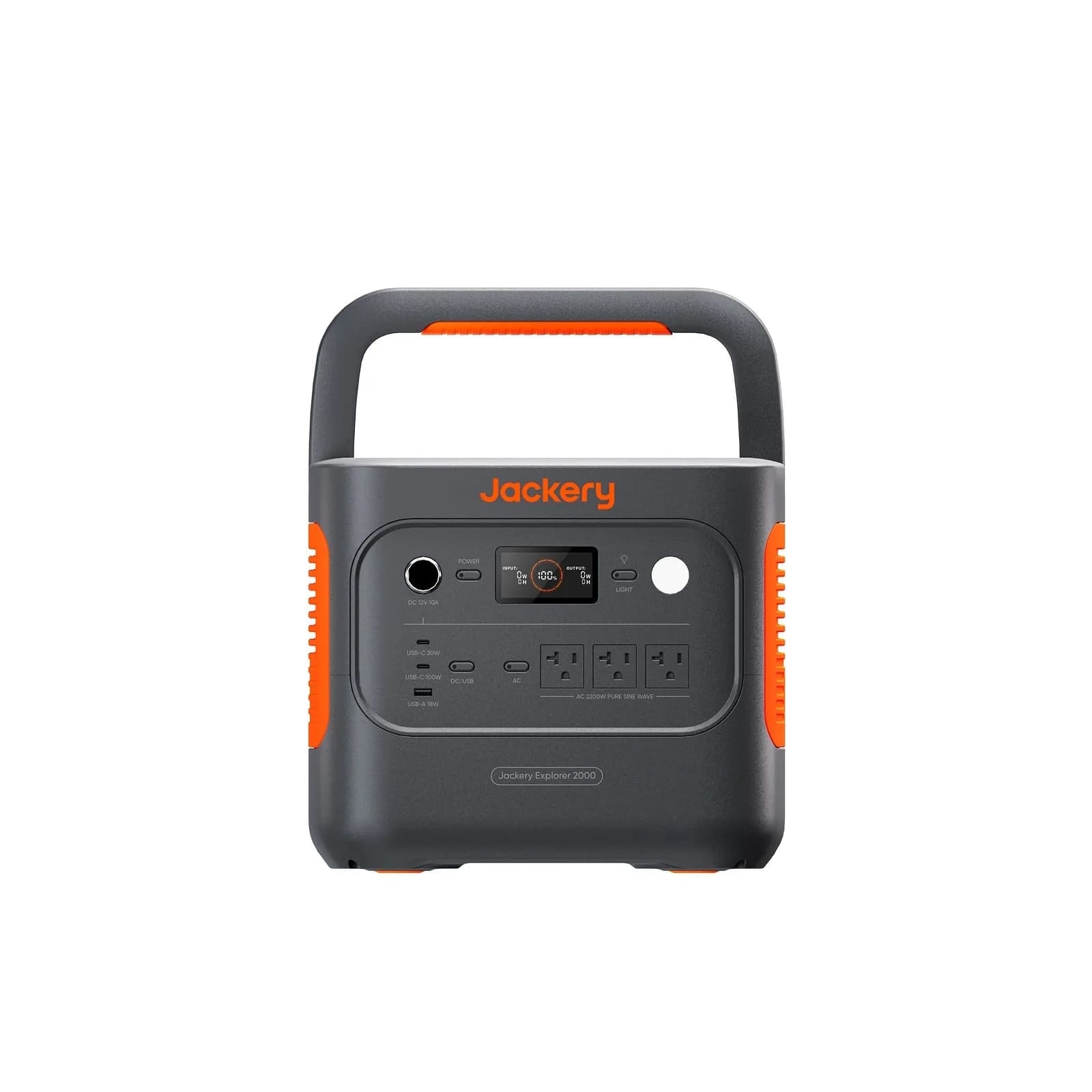
The Jackery Explorer 2000 v2 stores 2042Wh and outputs 2200W continuously with a 4400W surge, which Jackery says covers a refrigerator, microwave and coffee maker at once. Larger jobs need larger numbers: the Explorer 5000 Plus is rated for 7200W with a 14,400W surge, and its 5040Wh base capacity expands up to 60kWh.
Switchover speed matters if anything on the circuit dislikes a power interruption. Jackery lists the Explorer 2000 v2's switchover at under 20ms, fast enough that a router, computer or NAS stays online through the transition instead of rebooting.
All three stations in this comparison use LiFePO4 (LFP) battery cells rather than NMC, the chemistry Jackery uses across its current lineup. That is also why the larger units below carry long cycle-life figures, covered in the buying guide section.

Jackery Explorer 2000 v2
2042Wh capacity, 2200W continuous output, and a sub-20ms switchover for essential circuits.
Jackery for Home Backup During Power Outages
Home backup usually means one of two goals: keep a short list of essential circuits alive, or back up most of the panel for days at a time. The size of a Jackery power station should follow that goal rather than the other way around.
For essential-circuit backup, the Explorer 2000 v2 above is sized for a refrigerator, microwave and coffee maker running together, with its sub-20ms switchover protecting networking gear through the transition.
For multi-day essential-circuit outages, the HomePower 3600 Plus starts at 3584Wh, expandable to 21kWh, which Jackery rates for 15 hours to 9 days of backup depending on load, with 3600W of output. Its battery is an EV-grade LiFePO4 pack rated at 6,000 cycles, which Jackery frames as up to 16 years of use, backed by a 5-year warranty.

Jackery HomePower 3600 Plus
What We Like
- Jackery rates the base unit for 15 hours to 9 days of backup depending on load.
- EV-grade LiFePO4 cells rated for 6,000 cycles, framed by Jackery as up to 16 years of use.
- Expandable capacity for households that outgrow the base 3584Wh pack.
What to Consider
- A single unit outputs 120V only; running 240V appliances such as a well pump or dryer needs two units connected together.
Jackery positions the HomePower 3600 Plus as a home-backup unit rather than a portable one: the expandable capacity and multi-day rating point at outage coverage more than camping or RV use, and it shares the same LiFePO4 chemistry as the rest of the current Jackery lineup.
At the top of the lineup, the Explorer 5000 Plus is built for whole-panel backup. Jackery rates it at 7200W with a 14,400W surge, and lists support for both 120V and 240V. Base capacity is 5040Wh, expandable up to 60kWh, which Jackery describes as backup lasting 13 days. Paired with the Jackery 60A Smart Transfer Switch, it can run up to 12 circuits at 120V or 6 circuits at 240V, routing power to the breaker panel instead of individual extension cords. A transfer switch is a permanent connection to your home wiring, so have it installed by a licensed electrician to local electrical code rather than wiring it in yourself.


Jackery Explorer 5000 Plus
What We Like
- Accepts up to 4000W of solar input and recharges in about 2 hours.
- Scales all the way to 60kWh, which Jackery frames as roughly 13 days of backup.
- With the Smart Transfer Switch, covers up to 12 circuits at 120V or 6 at 240V.
What to Consider
- Reaching the full 60kWh means adding battery packs over time, and whole-panel coverage needs the separate Smart Transfer Switch hardware.
The Explorer 5000 Plus is the option for households that want a generator-style setup without a fuel tank: dual voltage, high continuous output, and an expansion path that scales well past what a single portable unit can hold.
Jackery for RVs and Vans: Continuous Watts, Surge, and Voltage
RV and van setups put more weight on continuous watts and surge than on raw watt-hours, because most rigs run a rotating set of appliances rather than the whole house at once. A compressor-based AC unit or a residential-style fridge draws a short surge on startup, then settles to a lower continuous load.
The Explorer 2000 v2's 2200W continuous output and 4400W surge gives that startup headroom, and Jackery's stated 0-to-100% AC recharge in about 1.7 hours means a stop at a campground hookup or shore power can top the battery back up between drives. At roughly 39.5 lb (17.9 kg), it is light enough to move between a rig and a campsite without a dolly, and Jackery rates it at under 30dB, which matters in a van parked overnight next to other campers.
Larger rigs with a dedicated 240V shore connection or a residential-style panel look more like the home-backup case above: the HomePower 3600 Plus or Explorer 5000 Plus scale further, at the cost of more weight and a bigger footprint to store on board. If your rig also carries a water system, our off-grid watermaker guide walks through the same 12V load-budgeting exercise for water rather than power.
Jackery for Camping and Off-Grid Trips
Camping and off-grid use adds a constraint the other two situations don't have: no wall outlet to recharge from. That makes solar input, not just battery size, the number to check.
Jackery's SolarSaga 200W is a bifacial folding panel with an IP68 waterproof rating and an ETFE-laminated case, sold with a 3-meter multi-functional cable with USB charging ports and a DC8020-to-DC7909 adapter in the box. On the larger end, the Explorer 5000 Plus accepts up to 4000W of solar input and recharges in about 2 hours under those conditions, more suited to a basecamp setup than backpacking.
If you're weighing a second LiFePO4 lineup for off-grid charging, our Jakiper battery guide covers a different brand's take on the same sizing questions.

Jackery SolarSaga 200W
What We Like
- Box includes the 3-meter multi-functional cable and DC8020-to-DC7909 adapter, so nothing extra to buy for a compatible station.
- Bifacial cells can pick up reflected light in addition to direct sun.
- Folds down for storage and transport between campsites.
What to Consider
- Needs a clear, sunlit spot to fold out and angle correctly, which isn't always available at a shaded or wooded campsite.
For anyone charging away from a wall outlet, the SolarSaga 200W is the piece that turns a Jackery power station into an actual off-grid setup rather than a battery that only gets one charge per trip.
Jackery Power Stations Compared
The table below lines up the four current models on the numbers that decide the fit. For a look at how a competing LFP lineup splits the same capacity tiers, see our Pecron portable power station guide.
Here is how the three stations in this guide line up on the numbers that decide sizing: capacity, continuous and surge output, and voltage support.
| Model | Capacity | Continuous / Surge Output | Voltage | Best For |
|---|---|---|---|---|
| Explorer 2000 v2 | 2042Wh | 2200W / 4400W | Standard AC | Portable backup, RV, camping |
| HomePower 3600 Plus | 3584Wh, expandable to 21kWh | 3600W | 120V (240V with 2 units) | Home backup, multi-day outages |
| Explorer 5000 Plus | 5040Wh, expandable to 60kWh | 7200W / 14,400W | 120V and 240V | Whole-home backup |
The Explorer 1500 v2 isn't in this table: Jackery's own US store lists it as sold out and points buyers to the HomePower 2000 Plus v2 instead, so it isn't a current option to size a setup around.
Common Sizing Mistakes to Avoid
Buying for watt-hours alone
A bigger Wh number doesn't guarantee a station can run what you need right now. The Explorer 2000 v2's 2200W continuous, 4400W surge rating is what actually decides whether a specific appliance starts and keeps running, not the 2042Wh capacity by itself.
Ignoring voltage requirements
A 240V dryer, well pump, or some RV AC units won't run on a 120V-only setup no matter how much capacity is available. The Explorer 5000 Plus supports both 120V and 240V on its own, while the HomePower 3600 Plus needs two units connected together to reach 240V.
Assuming every model recharges the same way
Recharge speed doesn't scale evenly with capacity. Jackery lists the smaller Explorer 2000 v2 at 0-to-100% in about 1.7 hours on AC, while the far larger Explorer 5000 Plus recharges from solar in about 2 hours because it accepts a much higher solar input. Check the charging spec for the exact model, not just the family.
What to Look for Before You Buy
Continuous watts vs. surge watts
List every appliance you plan to run at once and add up its continuous draw, then check the single highest surge draw against the station's surge rating. Motors and compressors are almost always the number that catches people out.
120V vs. 240V support
Confirm whether your heaviest appliance is 120V or 240V before comparing capacity. A dual-voltage unit like the Explorer 5000 Plus removes the guesswork; a 120V-only unit means either skipping 240V appliances or adding a second unit.
Switchover speed for sensitive electronics
If a router, NAS, security system or medical device needs to stay powered without a reboot, check the switchover time. Jackery's sub-20ms figure on the Explorer 2000 v2 is fast enough that most networking gear won't notice the transition.
Battery chemistry and warranty
All three stations use LiFePO4 cells rather than NMC. On jackery.com, current power stations carry a 3-Year Warranty plus 2 Extra Years Free, which Jackery describes as exclusive to purchases made on its own site.
How We Chose
This comparison is built from Jackery's own published product specifications and catalog data, matched against three common use cases: home backup, RV and van power, and camping. No independent lab testing was performed; every figure above is Jackery's stated spec, cited at the point it is used.
The Bottom Line
Size a Jackery power station to the job: essential-circuit and RV backup fit the Explorer 2000 v2's portable 2042Wh pack, multi-day home outages call for the HomePower 3600 Plus's expandable capacity, and whole-panel backup is what the Explorer 5000 Plus and its transfer switch are built for.
Check Current Price at JackeryReferences
More Home & Outdoor Gear guides
 Space-Saving Home Gym Equipment: 5 Best Compact Picks (2026)
 Selk'bag SWYTCH Review 2026: Best Wearable Sleeping Bag?
 Wuben Flashlight Guide 2026: EDC, Tactical & Spotlight Models
 Jakiper Battery Guide: 6 LiFePO4 Systems Compared (2026)
 Crown Shades Canopy Guide 2026: Best Pop-Up Models Compared
 Kit Solare per Camper: Guida 2026 al Dimensionamento