OUXI Electric Bikes: The 2026 Fat-Tire E-Bike Brand Guide
OUXI electric bikes are a fat-tire, moped-style e-bike lineup built around the V8 family. Here is what the brand offers, how the V8, V8 Max, and V8 Mini compare, and how to choose the right motor and battery for you.
What is OUXI, and where does it fit among electric bikes
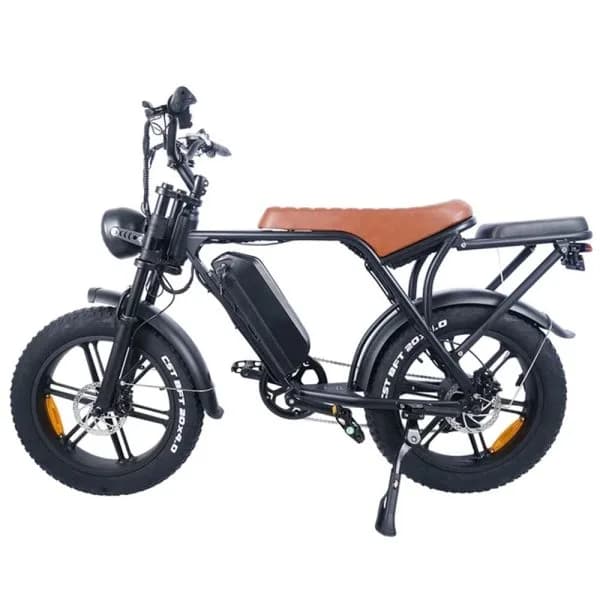
OUXI electric bikes are a fat-tire, moped-style lineup best known for the V8 family, a step-through frame paired with 20-inch fat tires built for riders who want stability on mixed terrain without learning a mountain-bike riding position. If you are early in your research and trying to figure out whether a fat-tire moped-style e-bike fits your commute, errands, or weekend trail riding, this guide covers what OUXI makes, how the V8 lineup differs, and what to check before you buy.
OUXI electric bikes are a fat-tire, moped-style brand built around the V8, V8 Max and V8 Mini
OUXI is best suited to riders who want a stable, cushioned ride over sand, gravel, or uneven pavement rather than a lightweight bike for fast group rides. If you want the full hands-on breakdown of the base model, see our OUXI V8 fat tire e-bike review.
- What OUXI is and where the V8 fits in the fat-tire e-bike category
- Why fat tires change how an e-bike handles on sand, gravel, and uneven roads
- How the V8, V8 Max, and V8 Mini differ in motor, battery, and frame size
- How to think about motor wattage and battery capacity for your own riding
- What OUXI's warranty, return policy, and safety certification actually cover
What is OUXI, and where does it fit among electric bikes
OUXI electric bikes are built around a distinct moped-style silhouette: a step-through frame, an extended bench-style seat, and thick fat tires rather than the diamond frame you would see on a typical hybrid or mountain e-bike. That layout puts the rider in a relaxed, upright position and lowers the step-over height, which is part of why the V8 lineup appeals to riders who want an easy-to-mount, stable-feeling bike rather than a sporty one.
The brand's core lineup is the V8 family, the standard OUXI V8, the extended-range V8 Max, and the compact V8 Mini: each aimed at a slightly different rider profile while sharing the same fat-tire, moped-inspired design language. OUXI describes itself as an integrated research, development, and manufacturing company, and sells both directly through its own site and through marketplaces such as Amazon. The brand states its manufacturing philosophy is to "only sell the best products," backed by warranty coverage and customer support.
Fat-tire e-bike basics: why the tires matter
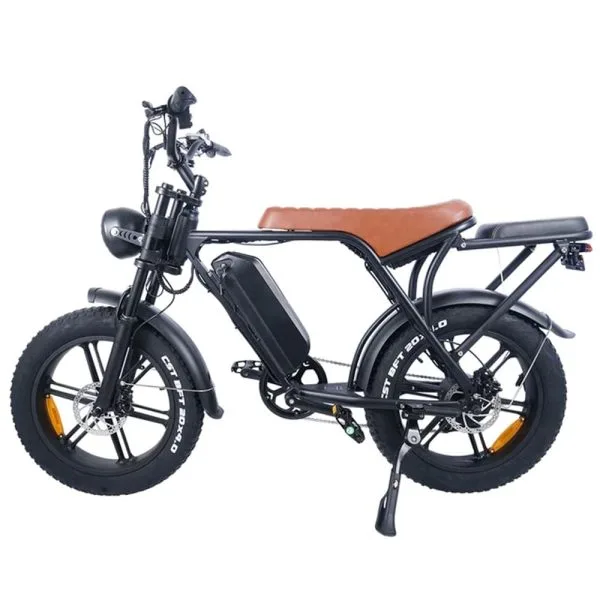
Before comparing specific models, it helps to understand what a "fat tire" actually changes about how an e-bike rides. Fat-tire e-bikes use tires 4.0 inches or wider, roughly double the width of a standard e-bike's 2.0–2.6 inch tires, which changes both traction and comfort in ways that matter for everyday riding, not just off-road adventures.
A 4-inch tire creates roughly 50% more ground contact patch than a 2-inch tire under the same load, which delivers higher static friction and a more planted, forgiving ride on sand, snow, gravel, mud, and pothole-filled pavement. That stability is a big part of why fat-tire e-bikes are considered approachable for new riders, heavier riders, or anyone who prioritizes control over outright speed.
Wider tires, together with reinforced frames, also tend to hold up better over time on rough surfaces. Fewer pinch flats and less drivetrain stress translate into fewer repairs and a longer usable life for riders who regularly encounter uneven terrain. Tire pressure itself adds to the comfort equation: every 1 PSI drop in pressure adds roughly 1 mm of radial compliance, which smooths out curb impacts and small vibrations without needing a full suspension system.
The OUXI V8 lineup compared
OUXI's V8 family splits into three variants that differ mainly in battery capacity and frame size, while keeping the same fat-tire, moped-style DNA. Here is how the specs stack up.
| Model | Motor | Battery | Claimed range | Tire / frame |
|---|---|---|---|---|
| OUXI V8 | 750W rear-hub (peak ~1000W) | Dual 48V 15Ah removable (30Ah total) | 56–74 miles claimed; ~35–55 miles realistic | 20"×4.0" fat tires, ~83.8 lbs |
| OUXI V8 Max | 750W motor, 1000W peak power | Dual 48V 15Ah removable (30Ah combined) | Up to 37 miles per full charge (vendor claim) | 20"×4.0" anti-skid tires, ~84 lbs |
| OUXI V8 Mini | 500W high-speed brushless motor | Removable 36V 10.4Ah | Up to 45 miles claimed; 25–30 miles realistic | 16"×4.0" fat tires, 16-inch compact frame |
OUXI V8: the standard fat-tire model
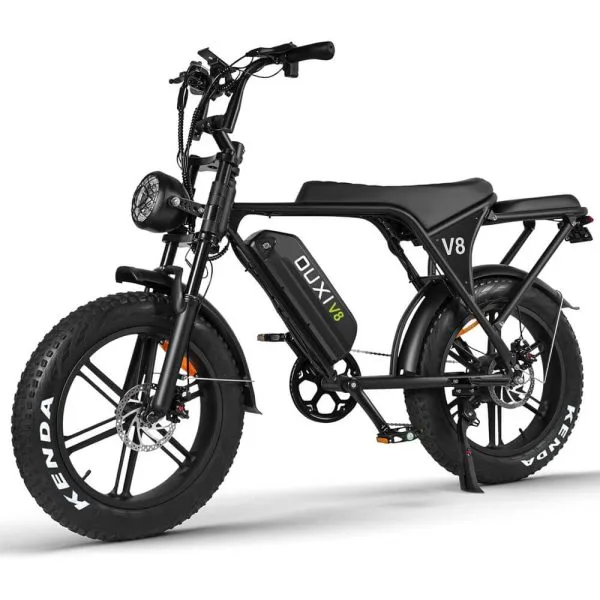
The standard V8 pairs a 750W rear-hub brushless motor (peak roughly 1000W) with dual 48V 15Ah removable lithium batteries for 30Ah of total capacity, giving it a claimed range of 56–74 miles that OUXI notes is closer to 35–55 miles in realistic mixed-condition riding. It runs on 20-inch by 4.0-inch CST fat tires with a metal moped-style step-over frame weighing about 83.8 lbs with both batteries installed, and is rated for riders from 5'4" to 6'5" with a 330 lb payload capacity. Braking comes from dual hydraulic disc brakes with a front suspension fork, and the electronics carry an IP54 water-resistance rating.
OUXI V8 Max: the extended-range dual-battery option
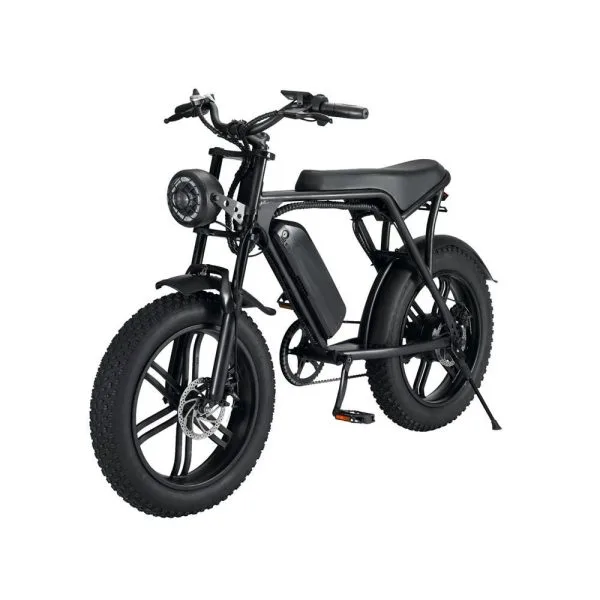
The V8 Max shares the same 750W motor with 1000W peak power and five pedal-assist levels as the standard V8, but is built specifically around its dual 48V 15Ah removable battery configuration, which the vendor lists as a claimed range of up to 37 miles per full charge, with a 7–8 hour recharge. It keeps the same 20"×4.0" anti-skid tires and moped-style frame at about 84 lbs total weight, and adds an M5 large-size LCD display showing speed, battery level, mileage, gear position, and lighting status. The vendor listing publishes no payload rating for the Max, so confirm the load limit with OUXI directly before buying if you ride heavy or carry cargo. The removable dual-battery design lets a rider swap in a charged second pack for longer days rather than waiting on a single battery to recharge.
OUXI V8 Mini: a compact frame for smaller riders
The V8 Mini scales the same design down: a 16-inch compact frame with 16"×4.0" fat tires designed for riders from 5'1" to 5'5" tall, powered by a 500W high-speed brushless motor with a removable 36V 10.4Ah battery. It tops out at 20 mph with a claimed range up to 45 miles (realistically 25–30 miles), and offers four riding modes (pure electric, pedal-assist, normal bike, and assisted walking) plus an HC80 smart display with NFC start. It is aimed at riders who want the fat-tire moped look and stability without the size and weight of the full V8, including apartment dwellers who need to carry the bike up stairs.
Choosing the right motor and battery for your riding
Once you understand what each OUXI model offers, the real decision is matching motor wattage and battery capacity to how you actually plan to ride, not just chasing the highest number on a spec sheet. If you are buying your first e-bike, our guide to buying an electric bike walks through the trade-offs in plain terms.
E-bike motors generally range from 250W to 1000W+, but wattage alone doesn't determine performance. Motor type, torque, and design matter just as much. A 250W mid-drive motor with strong torque can outperform a 750W hub motor on hills, and for most US riders seeking balanced power, comfort, and hill-climbing ability, a 500W to 750W motor offers the best everyday versatility. That range is exactly where the OUXI V8 (750W) and V8 Mini (500W) sit, which is worth keeping in mind if you're comparing OUXI to a lighter commuter e-bike with a smaller motor.
Battery sizing follows a similar logic. Battery capacity is measured in watt-hours (Wh): essentially fuel-tank size. A 500–750Wh battery supports consistent daily commuting range with reserve power, with 625Wh the usual sweet spot, while a 400–500Wh battery is enough for shorter trips under 10 miles on flat roads, keeping the bike lighter with faster charging. This is where OUXI's dual-battery approach on the V8 and V8 Max stands out: two 48V 15Ah packs add up to meaningfully more usable capacity than a single-battery competitor at a similar motor size.
Most e-bikes achieve 30–70 miles of range depending on battery size, terrain, and assist level, but advertised range figures are typically calculated under ideal conditions. Real-world riding with hills, stop-and-go traffic, and varied terrain usually cuts actual range by 20–40% versus the manufacturer's claim. That's consistent with OUXI's own published gap between claimed and realistic range on the V8 and V8 Max, so budget your expectations around the lower, real-world number rather than the headline figure. Battery life is the other thing to weigh against a warranty and return policy, since a pack is the single most expensive part to replace.
Warranty, returns, and safety certification
Before buying any fat-tire e-bike, it's worth checking what happens if something goes wrong, and what independent safety validation, if any, backs the electrical system.
OUXI covers return and exchange shipping costs for genuine quality issues, while non-defective returns carry a 20% restocking and shipping fee. The UL2849 standard specifically validates that the battery, charging system, and drive electronics work together safely, checking that batteries won't overheat or overcharge, the charging system is reliable, and there's no shock risk from the wiring, which is a more meaningful signal than a single component being UL-listed on its own.
Who OUXI electric bikes are for: and where to go next
OUXI electric bikes suit riders who want a stable, cushioned ride over mixed terrain (sand, gravel, light trails, uneven city streets) in a step-through frame that's easy to mount and dismount. The V8 and V8 Max fit taller or heavier riders who want longer range and don't mind the roughly 84 lb weight of a moped-style frame; the V8 Mini fits smaller riders or anyone prioritizing a lighter, more maneuverable package over maximum range.
If your priority is a lightweight commuter for mostly flat pavement, a smaller-tire hybrid e-bike may suit you better than a fat-tire moped-style build, and if price is your main constraint, our roundup of the best budget e-bikes of 2026 is a useful next stop. But if stability, ground clearance, and all-terrain confidence matter more than shaving pounds off the frame, the V8 family is built for exactly that use case.
For a full hands-on breakdown of the entry-level model (ride feel, real-world range, and where it falls short) read our OUXI V8 fat tire e-bike review next.
Where to go next
OUXI's fat-tire, moped-style lineup (V8, V8 Max, and V8 Mini) is built around stability and mixed-terrain confidence rather than outright speed. Once you know which frame size and battery capacity fits your riding, the next step is checking current availability and configuration directly with the brand.
View OUXI electric bikesSources
This guide is an independent overview based on brand specification pages and third-party e-bike reviews as of July 2026. Always confirm current specs, availability, and safety certification directly with OUXI before purchasing. Electric bike range, weight capacity, and speed vary with rider weight, terrain, and assist mode.
More E-Bikes & Scooters guides
 Revibikes Models Compared: 5 Best Picks by Rider Type (2026)
 Varstrom E-Bike Conversion Battery: Voltage & Capacity Guide (2026)
 Asiwo MAKO Review 2026: Best Entry-Level Sea Scooter?
 Soleil Supplies Review 2026: Best Tuttio & Yozma Upgrade Parts
 KuKirin Electric Scooters: Safe Buyer's Guide to All 14 Models (2026)
 ONESPORT Ebike Review 2026: 8 Models Compared, Best Picks