20ft vs 40ft Shipping Container: How to Choose the Right Size
20ft vs 40ft shipping container: compare dimensions, payload, condition grades, and delivery needs to pick the right size for storage or a workshop build.
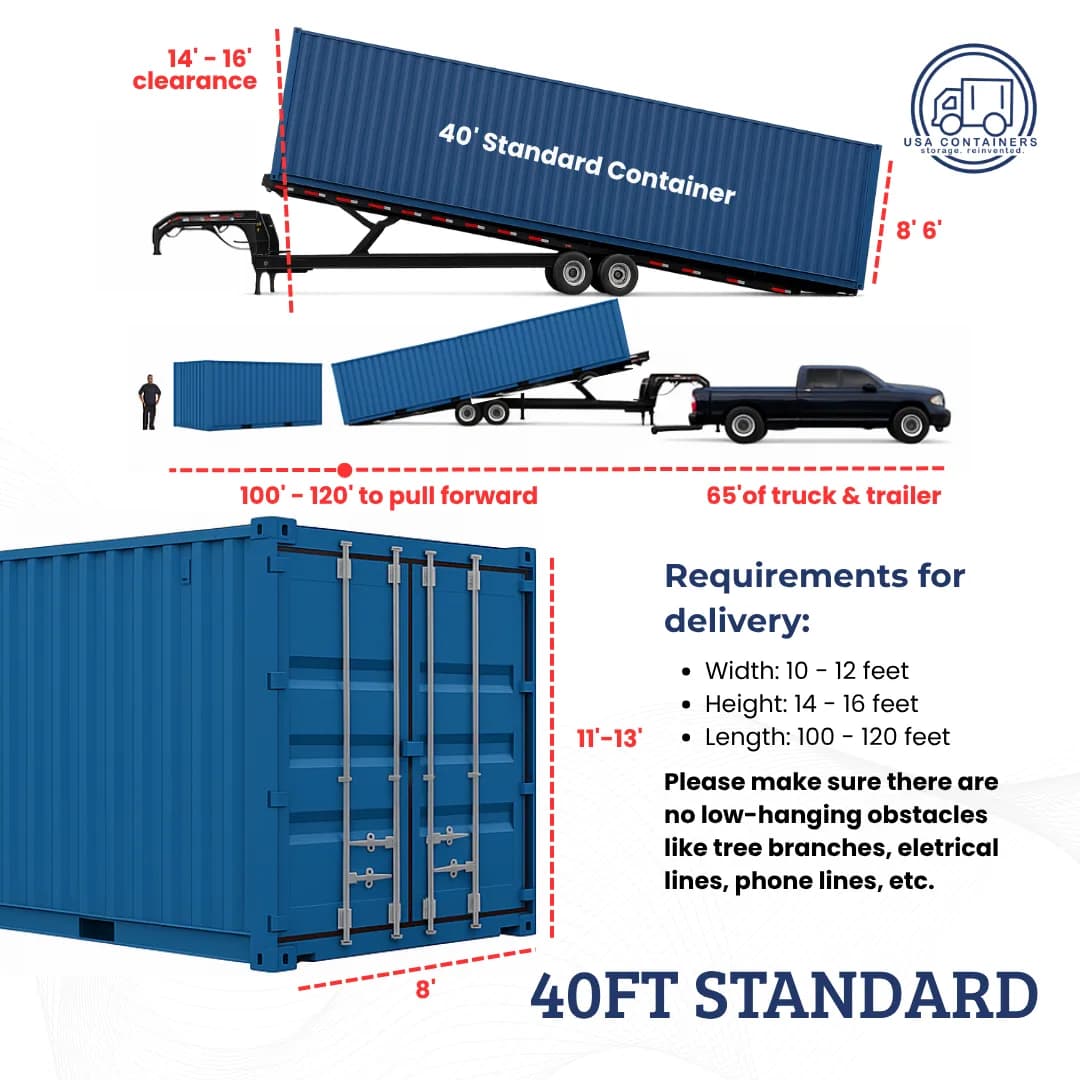
20ft vs 40ft shipping container: dimensions compared
Choosing between a 20ft vs 40ft shipping container comes down to space versus footprint: a 20ft box fits roughly 1,170 cubic feet into tight lots, while a 40ft box gives you about double the room for storage, workshops, or equipment. This guide breaks down dimensions, payload, condition grades, and delivery logistics so you can match the right size to your project.
A 20ft container suits tight sites and single-purpose storage; a 40ft (or 40ft high cube) fits full workshops, larger inventories, and multi-use spaces.
USA Containers sells and rents both sizes with a lifetime structural warranty and a 60-day money-back guarantee, so the risk of picking the wrong size is lower than buying used from a private seller.
Check container availabilityKey highlights
- A 20ft container holds about 1,170 cubic feet; a 40ft container holds about 2,350 cubic feet.
- 20ft payload capacity is roughly 48,500 lbs; 40ft standard payload is roughly 58,380 lbs.
- 40ft high-cube variants add about 344 cubic feet of extra headroom over a standard 40ft box.
- Condition grades (One-Trip, Cargo-Worthy, Wind/Water-Tight, As-Is) affect both price and structural expectations.
- Ground must be level within 3 inches across the container's length before delivery.
20ft vs 40ft shipping container: dimensions compared
Both sizes follow ISO 668, the international standard first published in 1968 that fixed container sizing so the same box can move by ship, rail, or truck without modification. Every ISO-compliant container shares the same 2.44-meter (8-foot) exterior width, regardless of length.
A 20ft container measures 20 feet long, 8 feet wide, and 8 feet 6 inches tall on the outside, giving about 1,170 cubic feet of usable volume.

A 40ft container measures 40 feet long, 8 feet wide, and either 8 feet 6 inches (standard) or 9 feet 6 inches (high cube) tall. Standard 40ft interior space runs about 39.5 feet long and 7.8 feet wide, or roughly 2,350 cubic feet. The high-cube variant stands a foot taller and adds roughly 344 cubic feet of extra headroom over the standard 40ft box.

| Spec | 20ft Standard | 40ft Standard | 40ft High Cube |
|---|---|---|---|
| Exterior length | 20 ft | 40 ft | 40 ft |
| Exterior width | 8 ft | 8 ft | 8 ft |
| Exterior height | 8 ft 6 in | 8 ft 6 in | 9 ft 6 in |
| Usable volume | ~1,170 cu ft | ~2,350 cu ft | ~2,694 cu ft |
| Pallet capacity | ~10-11 pallets | ~20-24 pallets | ~20-24 pallets |
| Max payload | ~48,500 lbs | ~58,380 lbs | ~58,380 lbs |


Browse current 20ft and 40ft inventory
USA Containers lists standard and high-cube options with delivery included in most service areas, backed by a lifetime structural warranty.
View available containersPayload capacity and weight limits
Volume isn't the only constraint — weight matters too, especially for dense cargo like tools, steel stock, or machinery. A 20ft container carries a maximum payload of roughly 48,500 lbs (22,000 kg).
A standard 40ft container has a tare weight of about 8,820 lbs, a maximum payload near 58,380 lbs, and a maximum gross weight around 67,200 lbs when fully loaded. High-cube 40ft models carry the same payload rating, just distributed across more interior height.
Because payload grows only modestly from 20ft to 40ft while volume roughly doubles, heavy, dense materials can hit the weight limit of a 40ft container before it's visually full, while lighter, bulkier inventory benefits more from the extra length.
Container condition grades explained
Price and structural expectations vary a lot by condition grade, and the terminology is fairly standardized across the industry:
- One-Trip: Made a single ocean voyage from factory to port; like-new paint and floors with minimal handling marks.
- Cargo-Worthy (CW): Typically 10-15 years old, meets U.S. Coast Guard standards for international shipping, with 95%+ structural soundness despite visible dents and surface rust.
- Wind/Water-Tight (WWT): Fully sealed for weather protection but can no longer meet maritime certification; shows heavier rust, fading, and dents.
- As-Is: Sold exactly as it sits, potentially with holes or corrosion; suited to buyers with repair capability.
For workshop or storage use, Cargo-Worthy and Wind/Water-Tight grades are the usual sweet spot — structurally sound without the premium of a One-Trip unit.
How to choose the right size for your situation
Match the container to what you're actually storing or building, not just the lot you have available:
- Construction sites and tool storage with moderate vertical clearance needs generally fit well in a 20ft container.
- Small workshops that need a bench, shelving, and daily foot traffic often outgrow a 20ft box faster than expected.
- Full workshop builds, larger equipment, and taller machinery are better suited to 40ft or 40ft high-cube containers, which USA Containers offers alongside the standard sizes.
- If headroom for working comfortably or storing tall equipment is a priority, the high-cube's extra height matters more than the standard 40ft's added length.

If you're also outfitting the container for daily use, pairing it with ventilation, shelving, or lighting accessories makes a big difference in how workable the space feels — see our guide to USA Containers shipping container accessories for storage and workshop builds for the specifics.
Site preparation and delivery access
Both sizes need a stable, level pad before delivery. The ground must be level within 3 inches across the full length of the container to prevent settling on one side. Concrete or asphalt is the ideal surface, with a compacted gravel bed as a common, cost-effective alternative.
Drainage matters just as much as level ground — water needs to move away from the container rather than pooling underneath it or in front of the doors, since standing water accelerates rust and floor damage over time.

A 40ft container needs meaningfully more straight-line clearance for the delivery truck to maneuver and set it down than a 20ft container does, so measure your access route — driveway width, overhead branches, gate clearance — before ordering the larger size.
Buy, rent, or rent-to-own: which option fits
USA Containers offers rentals for durations up to 2 years across both 20ft and 40ft sizes, with delivery and site placement included. Renting avoids upfront capital, ownership maintenance, and eventual disposal, which makes sense for a project with a defined end date. Buying makes more sense for a permanent workshop or long-term storage need, since ownership avoids ongoing rental costs and lets you modify the container freely.
Warranty and guarantee coverage
USA Containers backs its containers with a lifetime warranty on structural integrity, covering defects tied to manufacturing issues. The company also offers a 60-day money-back guarantee if a container is returned in its original condition, with no deposit required and full payment due upon delivery — which lowers the risk of committing to the wrong size before you've had the container on site.
The bottom line
If you're storing tools, materials, or equipment on a tight lot, a 20ft container is easier to site and delivers with less clearance hassle. If you're building out a real workshop, storing larger inventory, or need extra headroom, step up to a 40ft standard or high-cube container — the payload grows only modestly while usable volume roughly doubles.
Check current container pricingReferences
This guide is for general informational purposes and is not a substitute for a site survey or delivery quote from USA Containers or a licensed contractor. Container specifications, availability, and delivery access requirements can vary by location and should be confirmed directly with the vendor before ordering. Gearova may earn an affiliate commission if you purchase through links on this page, at no extra cost to you.
More Tools & Workshop guides
 Helical Cutterhead Upgrade Guide: 6 Compatible Machines (2026)
 Shipping Container Accessories: 10 Best Upgrades (2026)
 Pichi Design EDC Gear: Best Modular Tools Guide 2026
 Evolution Power Tools Review 2026: Best Multi-Material Saws
 Ssimder Review 2026: 5 Best Multiprocess Welders (Guide)
 FindBuyTool Review 2026: Best Machorool Woodworking Tools