TPE vs Rubber vs Carpet Car Floor Mats: How to Choose (2026)
TPE vs rubber floor mats: how thermoplastic elastomer, standard rubber, PVC, and carpet car mats compare on odor, cold-weather flexibility, custom fit, and coverage - so you can pick the right type for your climate.
How TPE, Rubber, PVC and Carpet Compare
- How TPE, Rubber, PVC and Carpet Compare
- Cold, Heat and Salt: Where Each Material Wins or Fails
- Custom-Fit vs Universal: Why Fit Method Matters as Much as Material
- Full-Floor, Cargo Liners and Truck Bed Mats: Which Coverage Do You Need
- How to Choose for Your Situation
- Cleaning, Odor and Warranty: What to Expect Long-Term
TPE vs rubber floor mats comes down to one core trade-off: TPE stays flexible and virtually odorless across a wide temperature range, while rubber costs less but stiffens below freezing and can carry a petroleum smell. This guide compares TPE, rubber, PVC, and carpet mats by fit, coverage, and winter performance.
If you already know you want a laser-scanned custom TPE set, our full 3W Liners review covers the Thorex TPE lineup, fit options, and warranty terms in detail. This guide focuses on the material and fit decision that comes before picking a specific brand.
A laser-scanned custom TPE set is the strongest all-around pick for cold, salt-heavy climates
If you drive somewhere that sees winter salt, sub-freezing mornings, or muddy commutes, TPE with a custom laser-scanned fit outperforms rubber, PVC, and carpet on the factors that actually matter: odor, cold flexibility, and edge coverage.
Check current priceKey Highlights
- TPE resists odor and stays flexible in extreme cold or heat, unlike rubber or PVC.
- Custom, laser-scanned mats seal corners and edges that universal mats leave exposed.
- Coverage ranges from door-to-door full-floor sets to cargo liners and truck bed mats.
- Winter-ready mats need deep enough channels to hold slush, snowmelt and salt.
How TPE, Rubber, PVC and Carpet Compare
TPE vs rubber floor mats is a material comparison between thermoplastic elastomer and vulcanized rubber. TPE is a polymer that combines rubber-like flexibility with thermoplastic processability, so it can be injection-molded into an exact floor shape without the sulfur-cure compounds and petroleum processing oils that standard rubber (SBR) needs.
Those processing oils are why rubber mats carry a petroleum smell: they "remain in the finished mat and slowly off-gas when the material heats up." A 3W Liners material-science breakdown states that quality TPE formulations "emit no odor, even under extreme temperatures ranging from -4°F to 167°F" and remain flexible across that entire range without hardening.
Longevity follows a similar pattern. According to the same source, TPE mats from quality manufacturers typically last 7–10+ years, versus 5–8 years for rubber, and PVC/vinyl mats that "wear out quickly." A comparison published by EV Trove, a retailer selling competing mats, describes TPE as "a hybrid material that combines plastic and rubber," noting it is heat- and UV-resistant without hardening, where rubber "may harden over time with prolonged heat exposure."
PVC brings its own weaknesses. A 3W Liners comparison notes PVC "tends to get stiff and hard to manage in colder climates" and "may curl up, crack or even stop fitting your car floor properly," alongside a strong plastic smell that can linger for weeks.

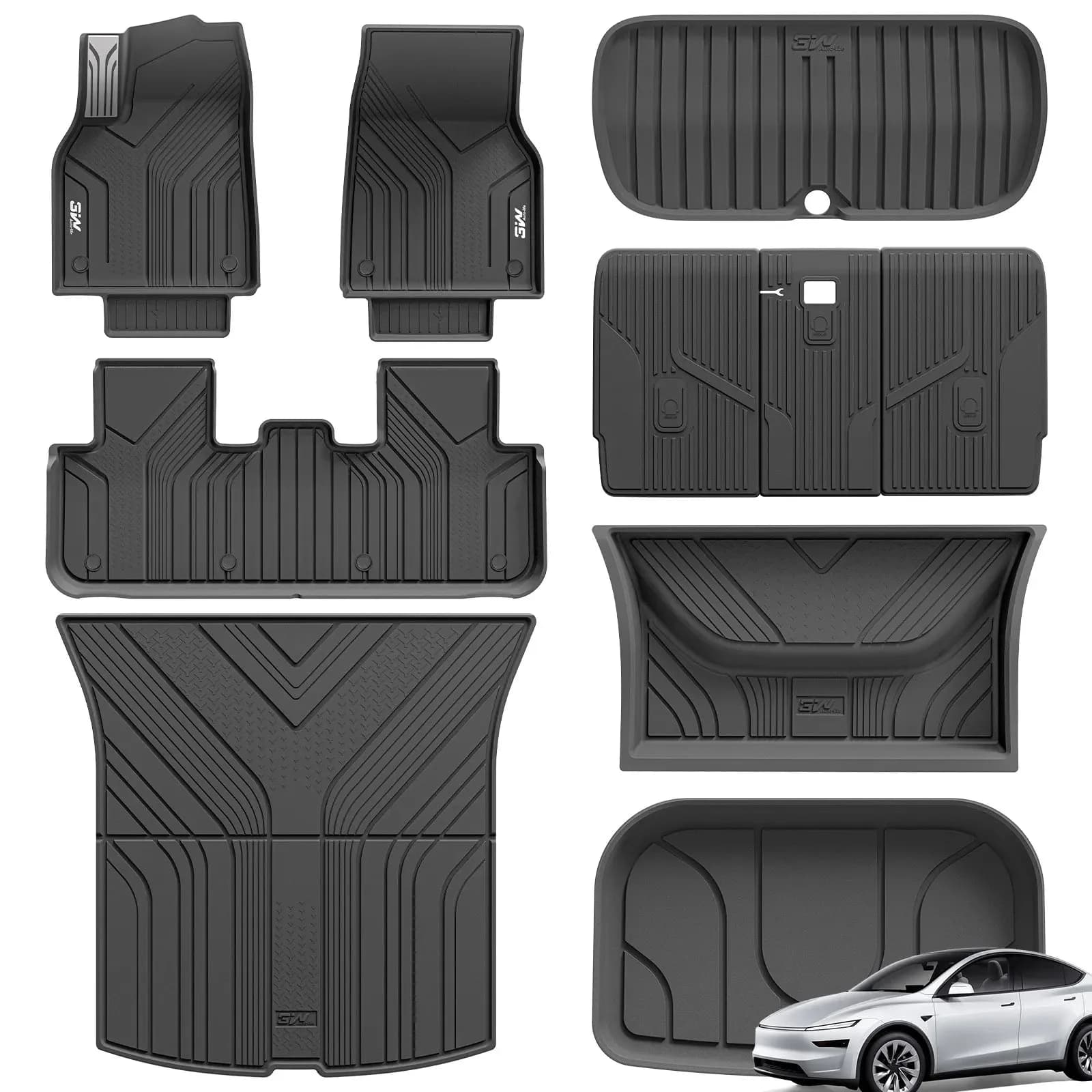
3W Liners Thorex TPE Custom Mats
Laser-scanned per vehicle, GRS-certified with minimum 50% recycled content.
Cold, Heat and Salt: Where Each Material Wins or Fails
Climate exposure is where the material differences become visible fastest. Below 0°F, standard rubber mats "stiffen significantly with edge curling near pedals," creating an uneven surface right where you need traction most. Rubber's petroleum odor also "recurs with each temperature cycle" rather than fading over time.
TPE is built for the opposite behavior. 3W Liners states its TPE formulation stays flexible from -4°F to 167°F without hardening or warping — a vendor claim rather than an independently tested figure.
PVC struggles at both extremes. A 12-month durability test tracking thermal cycling in cars reaching 130–170°F found corner warp was the most commonly documented failure during the heat-cycling phase, and by month 12, "edge cracking and debris embedding made replacement typically necessary."
Carpet mats fail differently — through moisture rather than temperature. "Water passes through carpet fibers immediately," and salt from winter roads binds to the fibers, requiring professional extraction to clean out. Carpet is described as the "most common source of interior odor in vehicles over three years old" because trapped moisture supports bacterial growth in the underlayer, capping typical carpet-mat life at 2–4 years.
Custom-Fit vs Universal: Why Fit Method Matters as Much as Material
Material is only half the decision — how the mat is shaped to your vehicle matters just as much. Custom-fit manufacturing uses 3D laser scanning to precisely measure every vehicle, then injection-molds the material into that exact geometry so rear mats "cover the entire floor from door to door and all the way under the rear seats."
Universal mats take a different, cheaper route: they're cut from flat sheets to approximate dimensions, which Lasfit, a retailer selling competing mats, says results in "poor fit since they're designed to fit a wide range of vehicle makes and models, which can lead to gaps or shifting." Those gaps are exactly where water and debris seep past the mat to the carpet underneath.
Lasfit's own custom-fit line shows the laser-scan approach is not unique to one brand: leading custom mat makers use "3D laser scanning to achieve a high-precision, vehicle-specific fit," with "each model verified in real vehicles to optimize coverage and ensure proper clearance around pedals and seat tracks."
Manufacturing process compounds the difference. Injection-molded custom mats feature "crisp, sharp edges," "uniform thickness," and consistent detailing, versus "cheaper thermoformed alternatives that have inconsistent quality and simpler designs" and are "prone to warping."

Full-Floor, Cargo Liners and Truck Bed Mats: Which Coverage Do You Need
"Floor mats" covers several different products, and picking the wrong coverage type is a common mistake. Full-floor custom sets provide first- and second-row mats that "cover the entire floor from door to door and all the way under the rear seats," with some brands offering a double-layered first row for the driver's high-wear zone — the same comprehensive cabin coverage that TPE cabin liners deliver.
Cargo and trunk protection is usually sold separately or bundled: many vehicle models qualify for a "1st & 2nd Row Mats + Trunk Mat" combination that extends protection beyond the cabin to other vehicle surfaces. Truck owners have a distinct category entirely — bed mats sized to the specific truck bed length, separate from the cabin floor set. Three-row SUVs need their own third-row mat to get full coverage; skipping it leaves the last row unprotected.

| Material | Cold-Weather Behavior | Odor | Typical Lifespan | Best For |
|---|---|---|---|---|
| TPE | Stays flexible to -4°F, no cracking or warp | Near-odorless, no sulfur/petroleum off-gassing | 7-10+ years | Cold climates, daily drivers, EVs |
| Rubber (SBR) | Stiffens, edges curl below 0°F | Petroleum smell recurs each heat cycle | 5-8 years | Budget buyers in milder climates |
| PVC/Vinyl | Stiffens in cold; corner warp in heat cycling | Strong plastic smell can linger for weeks | Wears out quickly, frequent replacement | Short-term or lowest-cost use only |
| Carpet | No inherent stiffening, but absorbs moisture | Common odor source in vehicles over three years old | 2-4 years | Dry climates, light use, showroom look |
How to Choose for Your Situation
Match the mat to how and where you actually drive, not to whichever material is cheapest on the shelf. A few common scenarios:
- Winter and road-salt climates: prioritize TPE with a channel depth of at least 1-1.5 cm to capture slush and salt above the carpet line, plus raised perimeter edges to stop spillover during braking.
- Daily commuters in mild climates: rubber can be an acceptable budget option if you're not seeing sub-freezing mornings, but expect a break-in odor period and shorter mat life than TPE.
- Families, pets and kids: skip carpet — its inability to shed moisture makes it the weakest choice for spills, muddy shoes and pet tracking.
- Trucks and work vehicles: pair a cabin floor set with a dedicated bed mat sized to your bed length rather than assuming one product covers both.
- Three-row SUVs: confirm the set includes a third-row mat — it's often sold and listed separately from the front two rows.

Cleaning, Odor and Warranty: What to Expect Long-Term
Care requirements track back to the same material properties. TPE's non-porous surface means a hose-off and wipe-dry is usually enough, and it "resists stains and smells" compared with carpet, which absorbs moisture into the fibers. Rubber needs more regular cleaning to slow surface cracking, and carpet mats exposed to road salt typically need professional extraction rather than a simple rinse.
Warranty coverage is worth checking before you buy, not after something fails. 3W Liners' lifetime warranty covers the vehicle's ownership period and includes material defects, non-normal cracking or tearing, and retention-clip failure, but explicitly excludes normal wear, accident damage, and non-transferable ownership changes. Read the exclusions on any brand's warranty page — "lifetime" terms vary widely on what's actually covered.
The Bottom Line
For most drivers — and especially anyone dealing with winter salt or unpredictable weather — a laser-scanned custom TPE set beats rubber, PVC, and carpet on odor, cold-weather flexibility, and edge-to-edge coverage. Rubber remains a reasonable budget fallback in mild climates only.
See 3W Liners TPE matsReferences
More Auto Accessories guides
 3W Liners Review 2026: Best Thorex TPE Floor Mats?
 Every Amp Review 2026: Best No-Drill EV Accessories
 MAXL ONE Review 2026: Does This Spray Coating Deliver?
 Motorcycle Tail Tidy Guide: Best Flip N Dip Kits (2026)
 MUCARUS OBD2 Scanner Review 2026: 5 Best Picks for DIY
 MUCARUS OBD2 Scanner Review: 6 Series Compared (2026 Guide)